


Ready to Take the Next Step?
Use our unique StructureSAFE app to map your company structure and generate your free structure diagram, or apply for Blaze Business & Legal’s Comprehensive Business Structure Analysis if you need detailed legal and structural advice.


Expert voices, industry data and ground-level intelligence on the pressures reshaping construction in 2026
The Australian construction industry entered 2026 already under pressure. Labour costs, material prices, insurance premiums and compliance burdens had been rising steadily. Builders were operating on margins that left almost no room for the unexpected.
Then the Iran conflict closed the Strait of Hormuz. Diesel surged. Fuel costs that were already embedded in every quoted price, every purchase order and every subcontract became a moving target overnight. Contracts locked in months ago at prices that assumed a stable cost environment are now being delivered in conditions those contracts were never designed to handle. The consequences are landing across the entire supply chain: delayed projects, disputed invoices, suppliers applying levies mid-job, and businesses that cannot complete what they have already started without absorbing losses they were never asked to price.
The voices collected here represent builders, lawyers, accountants, consultants, insolvency practitioners, civil contractors, peak bodies, industry bodies and commentators across Australia.
The construction industry in Australia entered 2026 already absorbing multiple simultaneous cost pressures. Shannon Drew, Management Accountant and Fractional CFO at Blaze Business & Legal, has modelled the combined impact of six simultaneous cost inputs across client portfolios. The finding is consistent, in that the total uncontracted cost impact of the current fuel crisis on active projects is two to three times higher than the direct diesel number. What Shannon has found is that a business which has calculated its diesel exposure at $180,000 often finds its full-portfolio exposure increased to $395,000 by the time it takes these other five cost impacts into account. Shannon has written a full analysis of the financial impact of the construction cost crisis on project margins →
Australian industry conditions declined materially in March, with the Australian Industry Index falling 19.9 points to -23.6, the steepest monthly fall since the initial pandemic phase of early 2020. Uncertainty was the main factor, with 30% of businesses reporting volatility in fuel prices, freight and supply arrangements. More than a quarter said rising costs were a major pressure across fuel, freight, raw materials, resins, plastics and packaging.
Construction, and civil in particular, is the most reliant Australian industry on diesel, contributing 79% of our energy. Civil Contractors Federation Australia has spoken to governments and national and state media about the rise in costs and the contract flexibility needed to work through the energy shock. Minimising price rises in maintenance and replacement costs of civil infrastructure requires the government working closely with the civil sector in the period ahead.
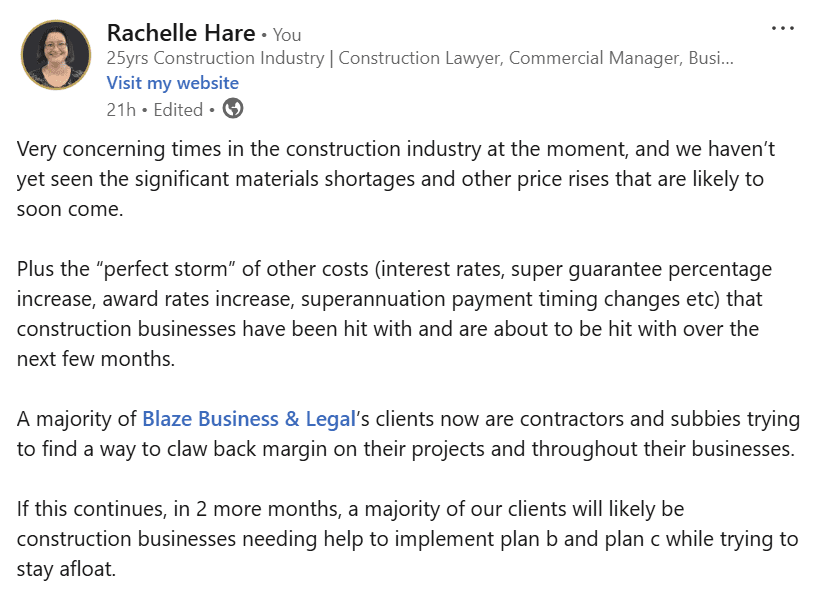
Diesel hit $3 a litre last week. We've got lump sum contracts locked in, purchase orders issued, and now suppliers are adding fuel levies or pushing back on supply unless prices move. Every path from here costs someone money that wasn't in the original deal.
For regional and civil contractors, the compounding effect is the biggest concern: fuel costs hit transport first, then materials, then every other input. There is no way to swap diesel out. It is what moves everything.
In recent weeks we have engaged with our supply chain, consultants and subcontractors to understand the real cost impact hitting active and pipeline projects. The picture is not uniform, but the direction is consistent, and the pace is faster than anything we saw coming out of COVID.
A national reef operator in Far North Queensland will see fuel expenses increase by $1 million dollars from February to end of financial year in June. Fuel shortages and fuel costs are impacting farmers, the tourism industry, and regional communities and small business owners. One in seven people in Far North Queensland are employed by tourism.
Our phones have rung off the hook this week. We have had a flood of enquiries from builders wanting to introduce cost-escalation clauses, and from homeowners seeking advice because some builders are now trying to cancel contracts that were only just signed. If they make the wrong move, the consequences can be significant. The smartest thing anyone in the industry can do is slow down, understand their legal position, and avoid making reactive decisions under pressure.
Australia imports roughly 90 per cent of its oil, and the country's refinery count has fallen from eight to just two. The shift has left Australia increasingly exposed to global energy shocks. Energy Minister Chris Bowen confirmed six oil shipments bound for Australia in April were turned back or deferred due to escalating tensions. The government has alluded to a "national crisis."
$9 per litre diesel by July? Sounds ridiculous until you actually run the numbers. Australia runs on diesel. We've got 20 to 26 days of supply. We import 90%, refined in Asia, but the supply chain runs through the Middle East for around 48%. We are at the very end of that chain. With flows constrained at 25%, that is where pricing breaks. With flows stalled, you are looking at a 60-plus per cent shortfall, and fast. That is not expensive fuel anymore. That is access. Industries start to slow, or stop.
The current fuel security issue was entirely predictable and, in fact, comprehensively predicted. No recent Australian government can say it was not warned. The "fair-weather" approach that plagues Australia's fuel security could not contrast more starkly with the concerted action directed towards critical minerals. The 2014-15 senate inquiry into Australia's transport energy resilience examined the very issues in which the country is currently mired.
"The global shocks we have been hit with this decade are not passing storms. They are extremes of a more volatile economic climate."
Fuel is the headline. Materials are where the damage compounds. The Reece Group notifications, cement surcharges and trucking levies represent confirmed, enforceable cost increases arriving mid-project on budgets that never included them. For businesses on fixed-price contracts, each of these increases transfers directly to margin.
Supply chains built on just-in-time delivery and imported product have nowhere to absorb consecutive shocks. The businesses most exposed are those with no forward procurement, no supplier agreements locking in prices, and no visibility into their cost-to-complete across the full project portfolio.
National average unleaded petrol reached 219.5 cents per litre for the week ending 15 March, up from around 169 cents before the conflict intensified. Diesel climbed to 245.6 cents per litre, with isolated reports of $3 per litre in parts of Sydney's northern beaches. The surge ranks among the sharpest in the developed world, per GlobalPetrolPrices data.
Diesel is up 36 per cent in two weeks. Petrol is up 30 per cent. Reece Group has notified customers of price increases of up to 36 per cent on HDPE pipe, 31 per cent on stormwater drainage products, and 28.5 per cent on PVC from 18 April. Cement is up 15 per cent on imports, 10 per cent on local manufacturing, with trucking adding another 12 to 15 per cent on top. CreditorWatch is already warning of another wave of insolvencies across construction, road freight, and every sector in between.
From where I sit advising on contracts and commercial risk, the real exposure for construction, mining and defence lies in the wider logistics and production ecosystem: urea, ammonium nitrate, industrial chemicals and other inputs that keep transport, earthworks, explosives and agriculture moving. Once those start to bite, the pressure shows up quickly in food prices, basic household needs, and wage and CPI expectations.
One of our SME transport clients is now spending an additional $10,000 per week on fuel costs for their trucks. That is not an annualised forecast. That is the cash flow hit landing in a single week. For businesses operating on thin margins with fixed-price commitments, there is no buffer. The question is whether the financial controls are in place to see the problem clearly before it becomes a solvency event.
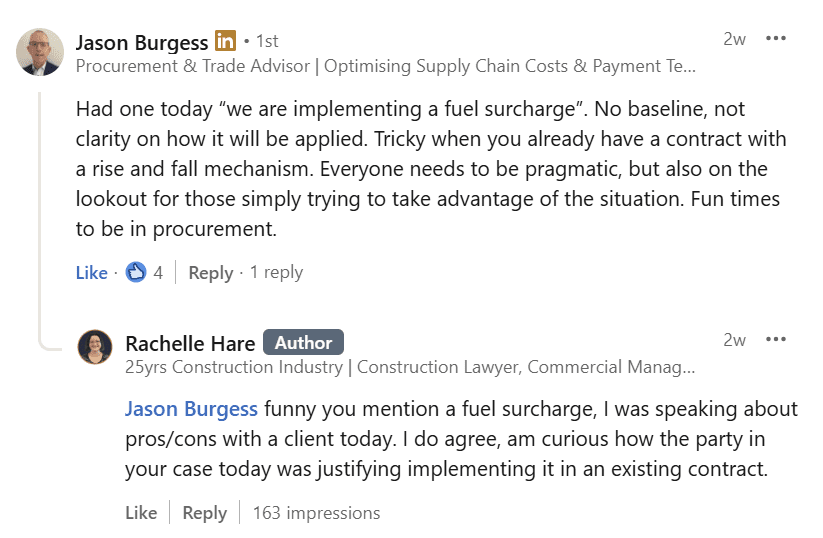
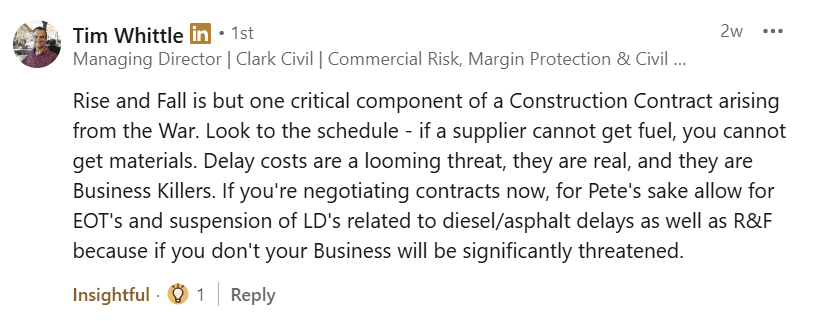
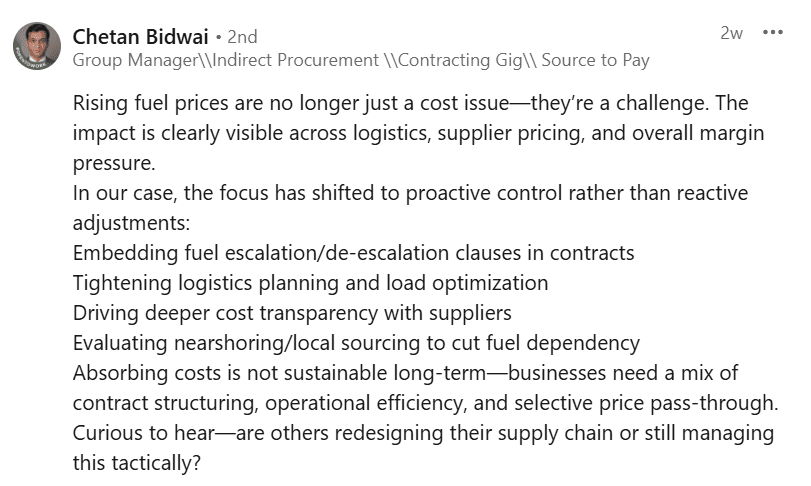
Fixed-price contracts did not cause this crisis. But they determine who absorbs the pain, and most of that pain is landing on contractors. The legal position of most businesses on live projects is worse than they think. Cost escalation clauses were crossed off at the negotiating table. Force majeure clauses were drafted narrowly. Time bars run regardless of what is happening in the Middle East.
The contractors navigating this best are the ones who reviewed their contracts before making any move, understood exactly what their clauses permit, and approached their counterpart with a documented position rather than a complaint.
By the time a contract is signed, both parties have agreed on the risk allocation in the document. In the current environment, that pricing has been overtaken by events that were not foreseeable at the time of tender. Cost escalation clauses were crossed off at the negotiating table. Force majeure clauses were drafted narrowly. Time bars run regardless of what is happening in the Middle East. Most contractors have less room to move in their contracts than they think.
The question in construction law is rarely about fairness. It is about what the contract says. Unless the contract includes specific mechanisms allowing cost adjustments, the financial burden often remains with the party who priced the job. Disputes rarely emerge at the moment the fuel price rises. They tend to appear months later, when contractors have absorbed multiple layers of additional cost and cash flow becomes the trigger.
The supply chain disruptions caused by fuel shortages will inevitably give rise to an increase in contractual disputes. Now is the time to review your contractual position, including any price escalation, termination for convenience or force majeure clauses, and to consider whether the doctrine of frustration may be relevant.
Whether a contractor can pass increased fuel costs on to the principal depends on whether the construction contract provides for cost escalation. Fuel scarcity due to the war in Iran is likely to qualify as a circumstance not reasonably foreseeable at the time of tendering, which could entitle the contractor to an extension of time.
The ATO fuel response measures are available until 30 June 2026. For eligible ABN holders who can demonstrate that fuel costs have specifically impacted their capacity to meet tax obligations, the payment plan provides real cash flow relief. The fuel excise cut reduces costs at the pump from 1 April, but the benefit reverses immediately on 30 June if the conflict has not resolved.
Most of the relief measures are reactive. Businesses need to apply, demonstrate eligibility, and navigate ATO processes. This is worth doing, but it does not substitute for understanding your legal position on live contracts.
If you need advice on your specific situation, this is where to start →
The ATO has launched temporary repayment plans for businesses struggling with surging fuel costs, and will limit compliance actions in the hardest-hit industries. Through the plan, eligible taxpayers can lock in three-year payment commitments, with equal monthly instalments and no upfront payment. The ATO's shift reverses a course of increasingly stern compliance measures that had been in place since the end of COVID-19 restrictions.
The ATO recognises that high fuel costs are affecting some businesses and will provide targeted support to eligible businesses unable to meet their payment obligations for three months, until 30 June 2026. This includes streamlined access to more flexible payment plan arrangements, including longer payment terms, no upfront payment, and access to general interest charge remission. If high fuel costs are affecting your business's ability to meet tax payment obligations and you are having difficulty getting working capital financing from your bank, please let us know.
From 1 April to 30 June 2026, the fuel excise tax has been cut in half, from 52.6 cents per litre down to 26.3 cents per litre. The Heavy Vehicle Road User Charge, previously 32.4 cents per litre, has also been dropped to zero for the same three-month period. Fuel tax credit rates for heavy vehicles on public roads are now 20.2 cents per litre, and for other business use off-road, 52.6 cents per litre. When the relief ends on 30 June, prices jump straight back up if the conflict has not been resolved.
We can't control the war in the Middle East. We can't stop the war in the Middle East, but what a responsible government can do is do everything it can to shield its citizens and to shield small businesses. The ATO has agreed to provide temporary relief for businesses unable to meet their tax obligations due to fuel supply issues, including more generous payment plans, remission of interest and penalties, and support in PAYG instalments where there's been a downturn in tax income.
The insolvency wave that followed COVID-19 has not fully unwound. Construction remains the highest-risk sector for insolvency in Australia. What the fuel crisis has added is a new trigger point for businesses that were already operating on thin margins, and a new source of uncertainty for builders who do not know what would happen to their QBCC licence or home warranty insurance if they needed to restructure. Marcus Petrovic's contributions below speak directly to that uncertainty: many builders in financial difficulty delay restructuring because they cannot get a clear answer on what restructuring would mean for their licence and their ability to keep operating.
The pattern is consistent: a business wins work at a competitive margin, costs rise during delivery, the margin compresses, cash flow tightens, and a payment dispute or variation rejection breaks the position.
This is where Blaze Business & Legal comes in, providing business, financial management and cash flow, legal, commercial, operational and compliance advice for businesses that are struggling but do not yet need to turn to formal restructuring and insolvency mechanisms. For those businesses that are in financial distress, directors who engage early, while the Small Business Restructure pathway and the statutory safe harbour under the Corporations Act are still available, have significantly better options than those who wait.
It's not just the variation in rules between states that creates confusion. It's the uncertainty around whether builders and tradespeople will actually be able to start again and retain their licence and insurance. Outcomes for similar situations can differ not only across states, but more concerningly, even within the same state authority. That uncertainty often leads to people putting their heads in the sand until things get too far gone. If there was more clarity and confidence around these issues, I think more people would make the call to restructure earlier.
There remains a critical and often underemphasised issue: the lack of consistency between state regulatory bodies, particularly in relation to licensing and home warranty insurance. Key areas of uncertainty include the treatment of a licence if insolvency occurs, whether it is automatically terminated, suspended or subject to a review process, the timeframe for reapplying, and the status of home warranty insurance during and after restructuring. These are fundamental questions for which even experienced industry professionals are often unable to provide definitive answers.
Even before this Middle East war, construction already had more insolvencies than any other industry, more than doubling since COVID. Despite huge demand for new housing, the 2024-25 financial year saw a record 3,490 construction firms enter insolvency. When builders collapse, the contagion spreads quickly: tradies lose jobs, subcontractors go under, projects stall and consumers face financial and emotional devastation. If this oil crisis lingers, more builders are likely to go bust, slowing down housing supply.
Directors concerned about the financial impact of rising fuel costs on cash flow need to understand what restructuring options are available. The statutory safe harbour regime under the Corporations Act 2001 can support genuine restructuring attempts while providing protection for directors who might otherwise face personal liability for insolvent trading. Such options may be available even if the director suspects the company may be, or is, insolvent.
Businesses delay restructuring not because they want to, but because they cannot get a clear answer on what will happen to their QBCC licence. Queensland's licensing regime has its own complexities, and those complexities do not pause for a fuel crisis. The businesses best placed are those that already understood their QBCC obligations and MFR requirements before things became urgent. By the time most call us, the options have narrowed.
The construction industry in Australia is entering the second half of 2026 with cost pressures that have eased from post-pandemic peaks but remain well above pre-2020 norms. RLB forecasts national construction cost growth of 4 to 6 per cent in 2026, with Brisbane forecast at 5 per cent and regional Queensland centres including the Gold Coast and Townsville up to 6 per cent. The Olympic pipeline is expected to intensify cost pressure in southeast Queensland from 2027.
The structural conditions that created the insolvency wave, fixed-price contracts without cost adjustment mechanisms, thin margins, long delivery windows, and cascading subcontract failures, have not changed. What is changing, slowly, is contract practice. Some principals are accepting rise and fall clauses on new contracts. Some government agencies are engaging on cost sharing. Some contractors are refusing to price without escalation allowances. Some suppliers are voluntarily sharing price increases with their small business clients rather than applying them in full, recognising that their own pipeline depends on those businesses surviving.
Australia has consistently chosen short-term cost savings over resilience, and now leans heavily on long, fragile global supply chains for essentials. Parties are much quicker to reach for force majeure, market disruption and hardship clauses, and owners, financiers and primes are more willing to cancel, defer award or terminate projects altogether. Without coordinated, non-partisan leadership including a genuine reset on domestic manufacturing and industrial capability, I expect to see further margin compression, more insolvencies, and a shrinking industry capacity at the very moment governments are relying on these sectors for housing, the energy transition and national security outcomes.
There is increasing anecdotal evidence suggesting a talent drain, with some tradespeople indicating a willingness to exit the sector altogether in favour of industries perceived to offer more stable income and less regulatory complexity. It may be timely to examine the introduction of a national licensing and building insurance framework to establish a consistent baseline across the industry.
Contractors are becoming more commercially savvy, but clients are becoming more unreasonable, and contractors are caught in the middle. There is a growing sense that the industry needs to say no more often: to contracts that push all risk downward, to compliance burdens that have nothing to do with getting the job built, to government procurement that sets prices below what delivery actually costs. Builder margins are lower than they have ever been.
Revamp the Australian Bureau of Statistics and get cost indices that actually work for their users!
Construction has a deeply combative information culture. Everyone holds information close because information feels like leverage. The result is a supply chain that cannot forecast. When force majeure clauses get invoked, it's often the final act in a slow deterioration that nobody in the chain could see coming, because nobody was sharing the signals that would have made it visible.
The current fuel security issue was entirely predictable and, in fact, comprehensively predicted. The "fair-weather" approach that plagues Australia's fuel security could not contrast more starkly with the concerted action directed towards critical minerals. No recent Australian government can say it was not warned.
At Blaze Business & Legal, we are in front of construction businesses every day. Shannon Drew, our Management Accountant and Fractional CFO, has been running the numbers on what is happening to margins across the industry. Rachelle Hare, our specialist Construction Lawyer, has been working through the contract implications.
Our current analysis puts the aggregate cost increase at 7 to 7.5 percent across the board, across fuel, materials, wages, super, insurance, interest rates, and government charges, with more to come in the second half of 2026. But numbers without voices are just numbers, and they don't tell us enough.
We want to hear from the people who are actually living this: contractors, subcontractors, principals, advisers, insurers, suppliers, financiers, industry bodies and commentators. Those who are struggling and those who are not. Those who have found solutions and those who are still looking.
All contributors will be credited and linked. Anonymous contributions can be published with your industry category and state noted.
Please include:
Choose the section that best matches your experience, or contribute to more than one:
Important (please read)
This report draws on published articles, LinkedIn posts, direct correspondence and professional observations shared for the purpose of industry commentary. Quotes have been reproduced accurately and in full context to the best of Blaze Business & Legal's knowledge. Statistics in the stats bar are attributed to their sources. All source URLs were accurate at the time of compilation in April 2026. Rachelle Hare and Shannon Drew's contributions represent their perspective of, and obligations on, the construction industry and do not constitute legal, financial management or business advice.
If you believe your published article or post has been inaccurately quoted, or if you do not wish it to be shown on this page, please email enquiry@blazebusinessandlegal.com.au with the relevant information and we will promptly take it down.