
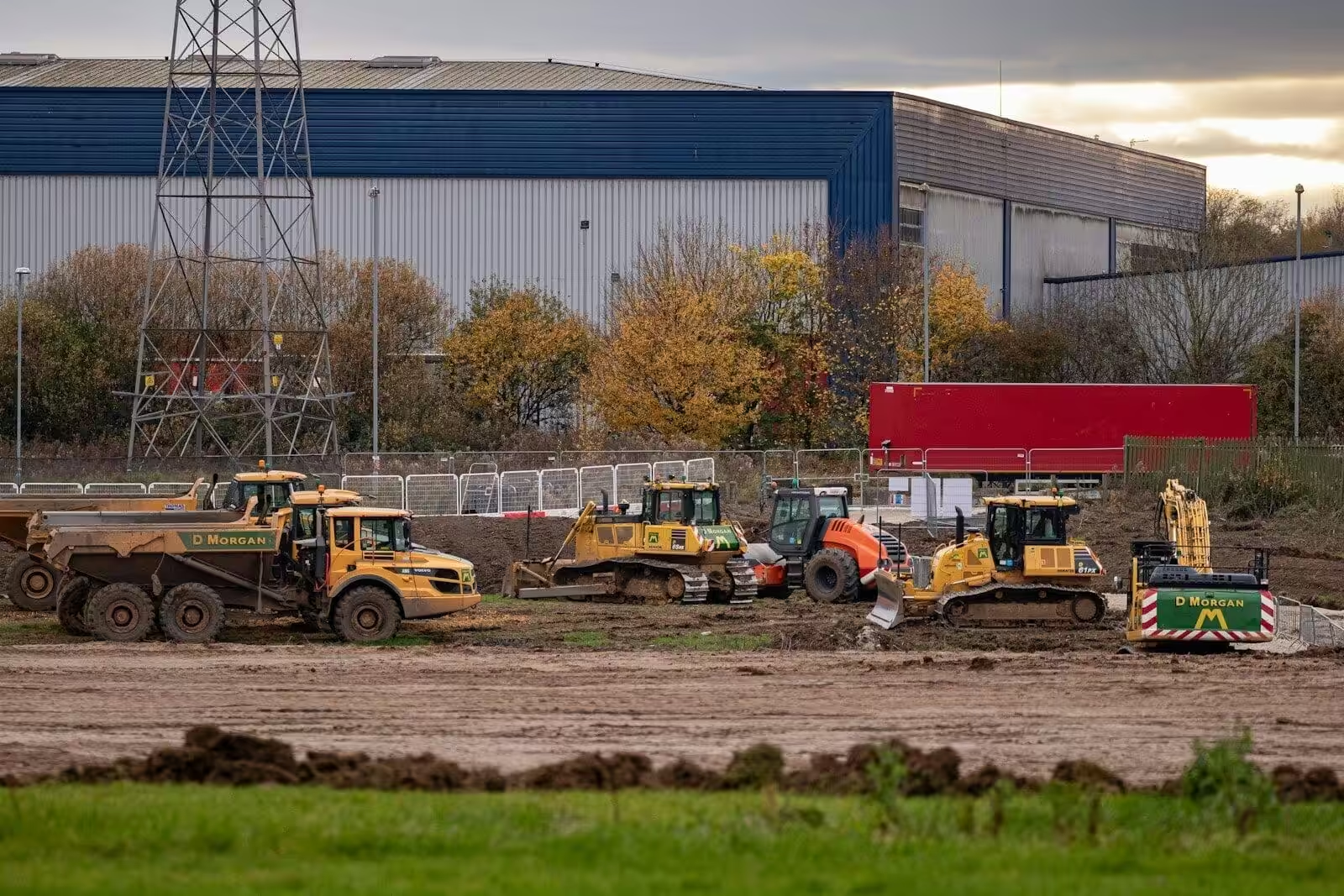
Three things are hitting almost every construction business right now
Contractors priced work before their input costs rose, and they are still delivering it. Diesel rose around 36 per cent in two weeks at the start of the fuel crisis (BuiltGrid analysis dated April 2026). PVC pipe and HDPE rose 27 to 36 per cent (Reece and Iplex price notices issued in April 2026). Cement rose 10 to 15 per cent on local manufacturing and another 15 per cent on imports, with trucking adding 12 to 15 per cent on top (BuiltGrid analysis dated April 2026). Contractors delivering contracts signed before all of that are wearing the difference.
Principals are holding retention and security far longer than Contractors expected at signing. Superintendents are running Defects Liability Periods drafted at 12 months out to two and three years on heavily amended contracts, where nobody checked the rectification clause before the Contractor signed. Principals hold bank guarantees against several completed projects in the same business at once, tying up facility the Contractor needs to fund the next job.
Head Contractors are issuing subcontracts that do not sit back-to-back with their head contracts. Procurement teams pull the subcontracts from old templates without checking them against the current head contract terms. Where the head contract pushes a risk onto the Head Contractor and the subcontract does not push that risk down to the Subcontractor, the Head Contractor wears it alone with no way to recover it. Most Head Contractors find out when something goes wrong on a project.
The 2026 cost and insolvency figures
At the start of the 2026 fuel crisis. Source: BuiltGrid analysis dated April 2026.
Source: price increase notices issued by Reece and Iplex in April 2026.
With trucking adding 12 to 15 per cent on top. Source: BuiltGrid analysis dated April 2026.
The highest of any industry sector since FY2022. Source: Cathro & Partners analysis of ASIC data.
Australia’s trucking sector consumes over 50 per cent of all diesel used nationally. Source: ABS data.
On a typical civil infrastructure project. Transport and logistics add a further 5 to 10 per cent. Source: Infrastructure Australia.
Fix the pricing method before you argue the claim
I spent years inside Tier 1 and Tier 2 Contractors, and the pattern I saw from the inside is the same one I see now from the outside. A Contractor almost never rings me about the decision that caused the loss.
Somebody rings me about a Payment Claim the Principal has knocked back. By the time I have read the Contract, I can usually see three earlier failures. The estimator priced the job on an assumption nobody tested, nobody instructed the Variations in writing, and nobody served the notices inside the time the Contract allows.
I write about the earlier failures, because a Contractor can still fix the pricing method, the Variation process and the way the business handles notices. The Payment Claim itself is often the only part that has already run out of road.
The 3 Construction Industry Issues we are tracking right now
The Construction Cost Crisis
The 2026 fuel crisis and the effects running through materials, margins, contracts and project viability at every tier of the industry. Rachelle is tracking this issue more closely than any other right now.
Read our analysis on the Construction Cost CrisisBrisbane 2032 Olympics readiness
The Olympic infrastructure pipeline is the largest construction opportunity Queensland has seen in a generation. Construction businesses that want to work on it need to be ready well before 2028, rather than after the Principals have awarded the work.
Read our analysis on Brisbane 2032 readinessConstruction business structuring
Most construction business owners we work with started small and grew. Owners who set up a structure at that point rarely go back to it, and the structure they chose then can quietly limit growth, asset protection, succession and risk management years later.
Read our analysis on construction business structuringConstruction Industry Issues we are writing about next
Most published commentary on the 2026 fuel and materials shock takes the Head Contractor and developer position. Subcontractors are wearing a different version of the same shock, and Rachelle is writing a separate set of pages for them.
Contractors working through Defects Liability Period issues raise the same statutory warranty questions often enough that Rachelle is building a dedicated section on them.
As Principals move Olympic infrastructure from planning into early contract awards through 2027 and 2028, Rachelle will expand the Brisbane 2032 pages from readiness analysis into procurement guidance for businesses bidding for and winning Olympic work.
FAQs about Construction Industry Insights
Rachelle Hare writes the analysis herself. Rachelle is a Construction Lawyer, Commercial Manager and Business Adviser with 25+ years of construction industry experience, including senior in-house roles at Tier 1 and Tier 2 Contractors and top-tier law firms, and six years full-time as a Commercial Manager.
We cover the issues hitting our clients hardest at the time. The Construction Cost Crisis covers the 2026 fuel crisis and its effects on materials, margins and contracts. Brisbane 2032 Olympics readiness covers the run-up to Olympic infrastructure delivery. Construction business structuring covers the structuring conversations we are having with growing construction businesses across Queensland.
Rachelle collated the Report from public commentary, including LinkedIn posts, public statements, industry submissions and other published material from across the construction industry. Each voice in the Report traces back to a real person and a real public source. Anybody can read the State of the Australian Construction Industry Report free online.
News reports what happened. We write about issues we are advising on directly, so a construction business owner or leadership team can use the analysis commercially, contractually or operationally. Every piece comes out of client work, contract review, financial review or commercial advisory we have run inside or alongside a construction business.
The 3 Construction Industry Issues published at the moment are the ones hitting our clients hardest. As the industry shifts and new problems come through, we will publish additional Construction Industry Issues and build the pages and articles underneath them.
Rachelle Hare publishes regularly on LinkedIn and works with industry organisations including the Queensland Chapter of the National Association of Women in Construction. Anyone wanting Rachelle to speak at an industry event, contribute to a publication or comment on an industry issue can call (07) 3063 3373 or email enquiry@blazebusinessandlegal.com.au.
Call Rachelle direct on (07) 3063 3373 or email enquiry@blazebusinessandlegal.com.au. Rachelle scopes the work with you and quotes a fixed price before she starts, then reads your Contract and tells you where your business stands on the issue you raised.
Blaze Business & Legal works from Suite 8, Level 7, 154 Melbourne Street, South Brisbane QLD 4101. We act for construction businesses across Queensland and the rest of Australia, and run most engagements by phone, video and document review.
Call Blaze Business & Legal on (07) 3063 3373 or email enquiry@blazebusinessandlegal.com.au. Rachelle takes the first call herself.
Ask Rachelle about what you are seeing on your projects
Rachelle takes the first call herself, and she will tell you whether what you are seeing on your own projects matches what she is seeing across the industry.
Or email enquiry@blazebusinessandlegal.com.au