

Fixed Price Building Contracts Australia: What They Cover | Blaze Business & Legal

Fixed Price Building Contracts in Australia: What They Cover, What They Don’t Cover and Where Builders Lose Money

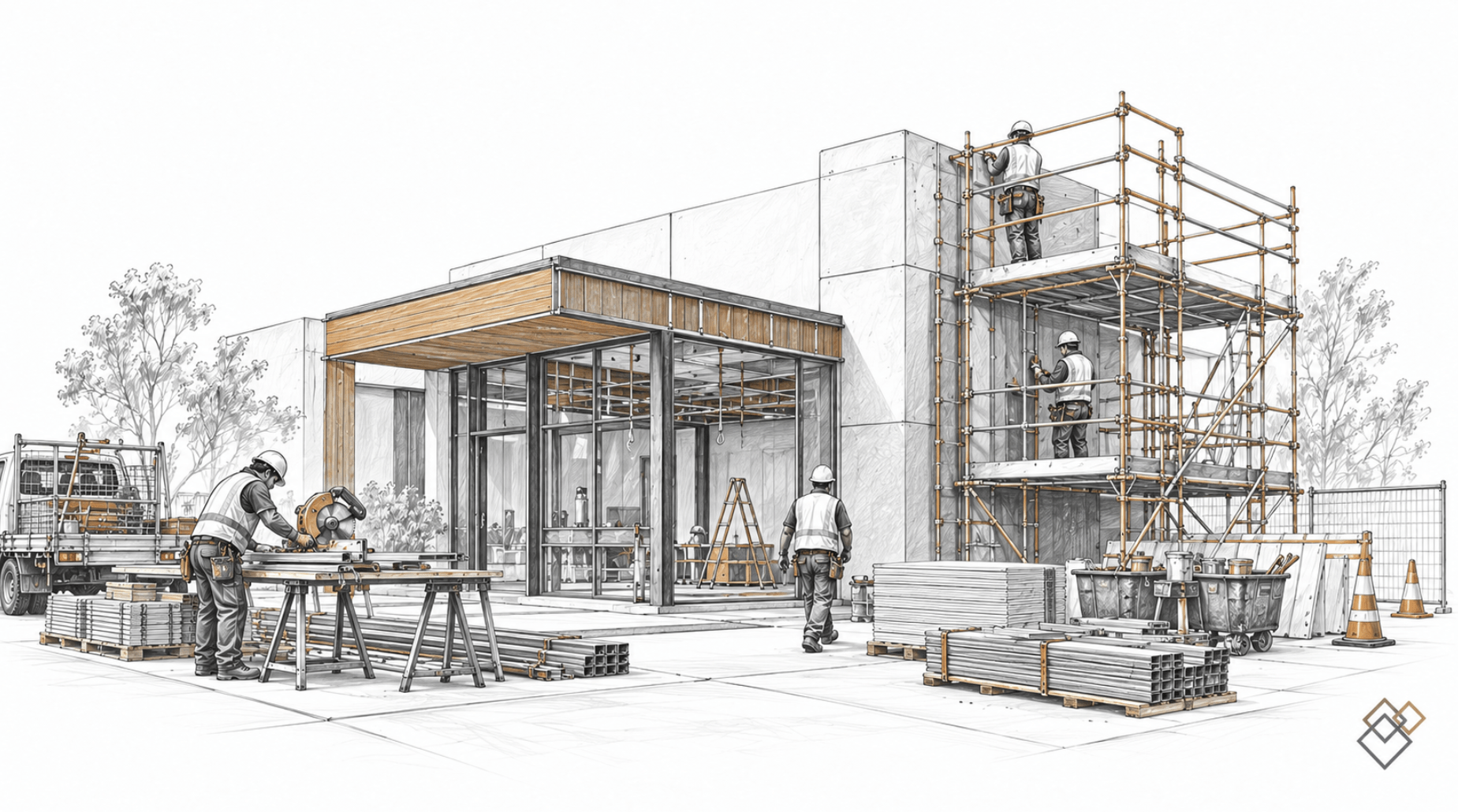
Construction site with trucks and construction equipment. Fixed Price building contract in construction
25+ Years Construction Law & Commercial Management
Tiers 1, 2 & 3 In-House at Thiess, Laing O’Rourke, Acciona
6 Years Commercial Manager at Defence and Tier 2
Senior Access Direct to Rachelle, No Juniors
Blog · Construction Contracts

A Fixed Price Contract gives the Principal cost certainty, but it does this by placing risk for most events on the Contractor. There are only a few defined opportunities for a Contractor to increase the Contract Sum after the contract is signed, and it's important the Contractor is aware of all of them if it wants to protect its Margin over the course of the Project.

Quick Answer

A Fixed Price building contract (also called a Lump Sum contract) fixes the Contract Sum the Principal will pay the Contractor for the Works defined in the contract. The price is fixed for the agreed scope, not for every cost the Contractor incurs. But this depends on the scope being defined just like the price.

The Contract Sum can only adjust through four mechanisms: Variations for changes in scope, Provisional Sums and PC Items for pre-agreed allowances, rise and fall clauses for defined cost movement, and deemed Variation triggers for specified events. Without one of those mechanisms, the Contractor wears the difference between the Contract Sum and the actual cost of doing the work.

Fixed Price contracts (also called Lump Sum contracts) are used across commercial, civil, infrastructure and residential construction in Australia, in standard forms such as AS 4000-1997, AS 2124-1992, GC21, ABIC, the Master Builders Queensland suite and the QBCC Domestic Building Contracts, as well as in bespoke head contracts written by Tier 1 Principals and in the Subcontracts that flow down from them.

Fixed Price Lump Sum Contracts are one of the most common types of construction contracts. The Contractor agrees a single price for the Works as defined in the Contract, and the Contractor takes the cost risk of delivering those Works for that price.

Before signing a Fixed Price Contract, it's important to identify which costs are excluded from the Lump Sum Price, which adjustment mechanisms the contract allows, and which entitlements the Contractor can lose by missing a notice deadline. The scope and requirements for the Works must be clearly specified, otherwise the Contractor may not be able to claim for extra costs they believe are outside the scope of the Contract. If a scope of work is included in the Fixed Price, the Contractor will be expected to undertake that work with no additional payment beyond the Contract Sum. That's where Contractors and Subcontractors can lose most of their Margin.

Quick Takeaways

  1. A Fixed Price contract fixes the Contract Sum for the agreed scope, not for every cost the Contractor incurs.
  2. The Variations clause is the only adjustment mechanism on a true Fixed Price contract without a rise and fall clause, and it only adjusts price for changes in scope, not changes in market cost.
  3. Provisional Sums and PC Items adjust differently: PS items adjust dollar-for-dollar on actual cost, while PC Items can carry a builder’s margin if the contract permits it.
  4. “Deemed Variation” clauses for latent conditions, statutory changes and Principal-supplied information create an entitlement to claim, but the entitlement is almost always limited by notice requirements, and the Contractor loses the entitlement if the notice is late.
  5. For residential work over $3,300 in Queensland, Schedule 1B of the QBCC Act prescribes the form of contract, and a non-compliant Fixed Price contract is voidable by the homeowner.
  6. A run of Fixed Price jobs going badly will trigger QBCC Minimum Financial Requirements reporting obligations before it triggers insolvency, and the licence is at risk before the cash flow is.
  7. Legal review of a Fixed Price building contract before signing is the single most commercially valuable decision the Contractor will make on that Project.

What the Fixed Price Covers

The Contract Sum is fixed for the Works as defined in the Contract at the time of execution, including the drawings, the specification, the schedules, the inclusions and exclusions, and whatever else the Contract picks up by reference. It is not fixed for work that falls outside the defined scope, items expressly excluded from the Lump Sum, or events the contract identifies as adjustable through its own mechanisms.

When the Contractor’s costs change during delivery (because the market has moved, the design has been revised, the site has produced unexpected conditions, or the Principal has changed its mind), the question becomes whether the Contract Sum moves with those costs or whether the Contractor absorbs them. The answer sits in the adjustment mechanisms the Contract preserves: Variations, Provisional Sums, PC Items, rise and fall clauses, and deemed Variation triggers.

On a standard form contract used unamended, those mechanisms tend to work as the drafters intended. On a heavily-amended bespoke contract or one with extensive Special Conditions, the Contractor’s cost protection can be materially narrower than the Contractor assumes. The difference between assuming protection and having protection often shows up only when a claim is submitted and rejected.

The Four Mechanisms That Adjust the Contract Sum

On almost every Fixed Price Contract you will encounter in Australia, the Contract Sum can be adjusted in four specific ways. Identifying the correct mechanism for each event is the work that determines whether the Contractor recovers the cost or absorbs it.

Mechanism 1

Variations

The Variations clause is the primary adjustment mechanism on a Fixed Price Contract that does not contain a rise and fall clause. It permits the Contract Sum to be adjusted for changes to the scope of the Works, including additional work directed by the Superintendent or the Principal, work omitted from the original scope, and work that has changed in character or nature.

The Variations clause does not permit the Contract Sum to be adjusted for changes in the market cost of work that was already within scope. If steel doubles in price between contract execution and the date the Contractor places the order, the Variations clause will not assist, because the scope has not changed.

The commercial mistake most Contractors make is treating cost movement on existing scope as if it were a Variation. A Variation Notice submitted for that purpose will be rejected, and the legitimate adjustment mechanism (such as a rise and fall clause or a deemed Variation trigger) sits unused while the time bars run out.

Rachelle Hare can help you with both situations: identifying and claiming legitimate Variations under the contract, and identifying the correct adjustment mechanism where a cost increase falls outside the Variations clause.

Mechanism 2

Provisional Sums and PC Items

Provisional Sums and PC Items are pre-agreed carve-outs from the Lump Sum for elements that could not be priced at the time the contract was signed. Although Contractors often treat them as equivalents, the adjustment rules and the margin entitlements that apply to Provisional Sums and PC Items are different, and the difference can be significant in dollar terms.

A Provisional Sum is an allowance for work the scope or extent of which is not fully defined at the time of contract execution. When the work is later carried out, the Contract Sum is adjusted dollar-for-dollar by the difference between the allowance and the actual cost of the work. There is usually no builder’s margin recoverable on the difference unless the contract specifically provides for one.

A PC Item (Prime Cost Item) is an allowance for a fixture or fitting that has not been selected at the time of contract execution. When the item is selected, the Contract Sum is adjusted by the difference between the PC allowance and the actual cost of the item supplied.

For residential work under Schedule 1B of the Queensland Building and Construction Commission Act 1991 (QBCC Act), the Contractor is entitled to a reasonable margin on the additional cost where the PC Item exceeds the allowance, provided the contract permits margin recovery. Many contracts drafted by Principals do not permit margin recovery on PC Item overruns, and on those contracts the Contractor absorbs the cost.

Mechanism 3

Rise and Fall Clauses

A rise and fall clause (also called a cost adjustment clause or price escalation clause) shifts a defined category of cost risk back to the Principal. Under this type of clause, the Contract Sum can be adjusted up or down in line with movements in a specified index, formula or documented cost basis. Common bases include movements in the ABS Producer Price Index for the relevant construction sub-sector, movements in published commodity prices for steel or copper, and actual documented cost increases passed through from suppliers.

For a rise and fall clause to operate at law, the clause needs to be sufficiently certain to be enforceable (meaning the trigger event, the method of calculation and any cap are objectively determinable), workable in practice (meaning the index, formula or cost basis can be calculated at the time the claim is made), and not unconscionable or unreasonable in operation. The first two requirements are where most disputes arise. The third is rarely a problem in commercial and civil contracts but can become relevant under the Domestic Building Contracts provisions of Schedule 1B of the QBCC Act.

Mechanism 4

Deemed Variation Triggers

A deemed Variation trigger is a clause that operates by treating a specified event as if it were a Variation, with the result that the Contract Sum (and, where relevant, the Date for Completion) is adjusted under the Variations machinery of the contract. The triggering events vary between contracts but commonly include changes in legislation that affect the cost of the Works, latent conditions that were not reasonably foreseeable at tender, errors or inaccuracies in Principal-supplied information, and directions by the Principal or the Superintendent that require the Contractor to accelerate the Works.

Depending on the contract, a deemed Variation trigger can give the Contractor an entitlement to additional time under the Extension of Time provisions, additional cost under the Variations provisions, or both. The reach of these clauses on a Fixed Price Contract can be significant, particularly where the Project has a long lead time between contract execution and mobilisation.

The entitlement under a deemed Variation trigger is almost always limited by notice requirements. The prescribed notice must be served within the prescribed time after the Contractor becomes aware of the triggering event, and if that notice is not served in time, the entitlement is extinguished by the operation of the time bar in the clause.

The Five Issues That Send Fixed Price Jobs Sideways

Most Fixed Price Contracts complete on or close to the Contract Sum the Contractor priced for, and the Contractor recovers a reasonable margin on the Project. The Fixed Price Contracts that fail commercially tend to fail for the same five reasons, and three of those reasons have very little to do with the price itself.

1. Tender allowances carried into the contract without re-pricing

The Contractor tendered the job in February. The Principal awarded in May. Contract execution slipped to July. By the time the Contractor mobilises in August, the Provisional Sum allowances for site preparation, the PC allowance for the kitchen fit-out and the rates for trades all reflect February pricing.

The Contractor has carried the tendered allowances into the executed contract without re-pricing them, and will absorb the difference between the February numbers and the August reality. The best way to avoid this is to re-price every Provisional Sum allowance, PC Item allowance, and rate-based component in the window between contract award and contract execution, and either negotiate the revised numbers into the Contract Sum or decline to sign on the original ones.

2. Scope ambiguity that the Principal resolves in its own favour

A Fixed Price Contract operates well when the drawings, the specification, the schedules and the Contract Sum are aligned with each other on what is included in the Lump Sum and what is not. Where there is inconsistency or ambiguity between those documents, the Principal will usually resolve the question in its own favour, and the Contractor will end up funding the gap between what was assumed at tender and what is being required on site.

The best way to avoid this is to insist on a clearly drafted order of precedence clause, an inclusions and exclusions list that is reviewed against the drawings and specification, and a Lump Sum inclusions schedule that records the basis on which the Contract Sum was calculated, all reviewed before the Contractor commits to the Contract Sum.

3. Self-censored entitlements and notice non-compliance that extinguish valid claims

This issue arises in two related ways. The first is where the Principal requests, or the Superintendent directs, additional work or accelerated delivery on the Project, and the Contractor simply carries the work out on the assumption that asking for a Variation might damage the commercial relationship. By the time the Project is approaching Practical Completion, the additional work has been done and the entitlement to claim it has expired, because no Variation Notice was ever served. The Contractor has self-censored its way out of money it was contractually entitled to recover.

The second is notice non-compliance. The contract requires a written notice of delay, a Variation Notice, or a notice of latent conditions to be served within a specified period after the relevant event. The notice is either not served or is served outside the prescribed time. Under most standard-form contracts in Australia, the Superintendent is required to act impartially in assessing the claim, and even an impartial Superintendent has very little discretion to certify a claim where the time bar in the notice provision has not been complied with. The entitlement is extinguished, and a legitimate cost increase that the contract would otherwise have permitted is lost to a procedural failure.

4. Cash flow compression from progress claim certification disputes

The Principal is paying the Contractor on the value of work certified by the Superintendent, not on the value the Contractor has claimed. The Superintendent is certifying each progress claim at a lower value than claimed, on the basis that the work in place does not yet match the milestone or percentage-completion description used by the Contractor, or that certain inclusions or Variations claimed by the Contractor are not accepted as certifiable at that point in time. Across six monthly claims, the cumulative under-certification has reached $340,000.

The Contractor is funding the difference between claimed and certified value out of its own working capital, and is now approaching the limits of its overdraft and trade finance facilities. Despite the work having been done and the Fixed Price Contract entitling the Contractor to be paid for it, the Contractor is unable to access the cash on a timeline that allows the Project to continue without external finance.

This is technically a security of payment issue under the relevant Act in the State or Territory rather than a Fixed Price issue, but it is one of the most common ways a fixed price job that priced sensibly and was delivered well becomes a working capital crisis for the Contractor.

5. QBCC Minimum Financial Requirements exposure before insolvency

The Contractor has lost money on the last three Projects. The financial statements for the year just ended will show Net Tangible Assets at $180,000 against a Maximum Revenue limit of $3 million. The Contractor is required to notify QBCC of an MFR shortfall within 10 Business Days of becoming aware of it.

The Contractor’s licence is at risk before its cash flow is. The QBCC licensing exposure on a run of bad fixed price jobs typically arrives months before any insolvency conversation does.

Most builders do not see it coming because the trigger is a regulatory reporting obligation rather than a commercial one.

From the Building Site

I have advised plenty of Contractors who have lost six and seven figures on a Fixed Price Contract where the issue had nothing to do with the price. One lost the lot because the notice on a latent conditions event was served on day 16 of a 14-day notice window. Another carried a Provisional Sum allowance for piling forward from a 14-month-old tender straight into the executed contract without re-pricing it. A third had a PC Item margin recovery clause quietly deleted by the Principal’s lawyer in the Special Conditions, and nobody picked it up at Tender Review.

None of those losses were caused by steel or labour going up. All of them were caused by clauses the Contractor either did not understand or did not have time to read carefully before signing. Getting a Construction Lawyer to read the contract before signature is the cheapest piece of risk management you will buy on the Project.

Residential Work in Queensland: Schedule 1B of the QBCC Act

Where the Project is residential building work in Queensland and the contract price exceeds $3,300, an additional regulatory overlay applies. Schedule 1B of the Queensland Building and Construction Commission Act 1991 prescribes the form and content of the contract, including the requirement that the contract be in writing, the warnings and notices that must appear, the Notice to Homeowners, the deposit limits, and specific terms governing PC Items, Provisional Sums, progress payments and cost escalation.

A Fixed Price residential contract that does not comply with Schedule 1B is voidable at the election of the homeowner. If the homeowner terminates for non-compliance, the Contractor is entitled to recover the value of the work properly done but not its agreed margin or recovery of overheads, the homeowner may have a counter-claim for any defective work, and the QBCC may take licensing action against the Contractor for breaching the licensee’s obligations under the Act.

For builders using bespoke residential Fixed Price Contracts rather than the prescribed forms, Schedule 1B is one of the highest-risk areas of construction contracting in Queensland. A Schedule 1B compliance review of the contract is quick to do before signing and very expensive to address after the contract has been entered into.

Five Things to Do Before Signing a Fixed Price Building Contract

  1. Have a Construction Lawyer review the contract, ideally with input from a Commercial Manager who has worked on similar Projects. The cost of a fixed-price contract review is a small fraction of the loss it typically prevents.
  2. Re-price every Provisional Sum and PC Item allowance in the period between tender submission and contract execution. Document the re-pricing and either incorporate the new numbers or refuse to sign on the old ones.
  3. Map every notice obligation in the contract onto your project management system. If the Extension of Time notice is 14 days, the latent conditions notice is 7 days and the deemed Variation notice is 5 Business Days, those time bars need to live in your project register, not in a contract you read once and put in a drawer.
  4. Confirm that the contract complies with Schedule 1B of the QBCC Act if the Project is residential work over $3,300 in Queensland. If you are using a bespoke contract, get the compliance check done before you sign, not after the homeowner’s lawyer raises it.
  5. Check your QBCC Minimum Financial Requirements headroom before you take on a Fixed Price contract that materially changes your Maximum Revenue position. Talk to your accountant before talking to your lawyer.

Frequently Asked Questions about Fixed Price Building Contracts

The questions Contractors and Subcontractors ask most often when they are looking at a Fixed Price Contract for the first time, working through a claim mid-Project, or trying to understand whether a cost increase can be recovered under the contract.

Only where the contract permits it. The Variations clause permits adjustment for changes in the scope of the Works. Provisional Sums and PC Items are adjusted on actual cost when the work is done or the item is selected. A rise and fall clause permits adjustment for movements in defined cost categories. A deemed Variation trigger permits adjustment for specified events such as latent conditions or statutory changes. If none of those mechanisms applies to the cost movement in question, the Contract Sum stays as it was, and the Contractor absorbs the cost.

A Provisional Sum is an allowance for work whose scope or extent is not fully defined at contract signing. A PC Item is an allowance for a fixture or fitting that has not been selected at contract signing. Both adjust the Contract Sum by the difference between the allowance and the actual cost, but the rules for builder’s margin recovery on the difference are not the same, and the difference depends on the specific contract terms and (for residential work) on Schedule 1B of the QBCC Act.

Each form allocates risk differently. A Fixed Price Contract gives the Principal cost certainty and gives the Contractor the upside (and the downside) of efficiency. A Cost Plus Contract gives the Contractor cost recovery and the Principal carries the risk of inefficiency. Neither form is inherently better. The right form depends on how well the scope is defined, how comfortable both parties are with the price risk, and how much trust exists between them.

A deemed Variation clause says that on the occurrence of a specified event (such as a change in legislation, a latent condition, an inaccuracy in Principal-supplied information, or a directed acceleration), the affected work is treated as a Variation and the Contract Sum is adjusted under the Variations machinery of the contract. These clauses sit in many Fixed Price Contracts and create an entitlement to claim, but the entitlement is almost always limited by notice requirements. Late notice extinguishes the entitlement, even where the contract was described as fixed price.

Schedule 1B applies to domestic building work in Queensland where the contract price is more than $3,300 (Level 1 work). It prescribes the form of contract, the warnings and notices that must be included, the deposit limits, the rules around PC Items and Provisional Sums, and other terms that must be in the contract. A non-compliant Fixed Price residential Contract is voidable by the homeowner, and the Contractor faces both contract-law and QBCC licensing exposure on non-compliance.

Before signing. The contract review work that adds the most commercial value is the work that happens before the Contractor commits to the Contract Sum, the time bars and the risk allocation. Once the contract is signed, the lawyer’s role shifts from shaping the deal to managing the consequences of the deal as drafted, and the commercial room to move is materially smaller.

The available options depend on the specific contract, the cause of the cost increase, and the commercial relationship with the Principal. The starting point is to check whether the contract contains any deemed Variation triggers (for statutory change or latent conditions), whether the Lump Sum inclusions schedule supports a re-pricing argument on any element, and whether the Principal has given any direction that could properly be characterised as a Variation. Beyond the contract mechanisms, the next step is usually a structured commercial negotiation with the Principal supported by written advice on the contract position.

Get the Contract Reviewed Before You Sign

A Construction Contract Review identifies the clauses in the Fixed Price Contract that will cost the Contractor money on the Project, the time bars that need to be diarised from day one, the adjustment mechanisms the Contractor can rely on, and the changes worth negotiating before the Contract Sum is locked in.

Rachelle Hare reviews Fixed Price Contracts using experience gained from working with Principals, Superintendents, Contractors and Subcontractors over more than 25 years in the construction industry. She draws on six years as a Senior Commercial Manager on major Defence Projects, in-house construction law roles at Thiess, Laing O’Rourke, Acciona, DHA and UGL, and earlier private practice at Corrs Chambers Westgarth and McCullough Robertson. Construction Contract Reviews are delivered as written advice on a fixed-price quote.

Or email enquiry@blazebusinessandlegal.com.au

Share With Your Network

Rachelle Hare, Construction Lawyer, Business Adviser and Commercial Manager, Blaze Business and Legal
About the Author

Rachelle Hare

Construction Lawyer, Business Adviser and Commercial Manager|Blaze Business & Legal

Rachelle has more than 25 years of experience in construction law, business advisory, commercial management, contract administration and construction business structuring. Her career includes senior in-house legal roles at Tier 1 and Tier 2 construction companies including Thiess, Laing O’Rourke and Acciona, and private practice experience at top-tier law firms Corrs Chambers Westgarth and McCullough Robertson. She also spent over six years as a senior commercial manager on Defence and Tier 2 Construction and Technology Projects, including 8 months as Deputy Program Manager on a construction and technology program of National significance. At Blaze Business & Legal, Rachelle works alongside Shannon Drew to provide integrated construction law, financial management, commercial and business advisory services to construction businesses across Australia.

Reviewed byShannon Drew, Management Accountant, Costs Accountant, Fractional CFO and Business Adviser, with 25+ years of construction industry experience.

Let’s Chat About How We Can Help You

  • Contact us to discuss how we can help you and your construction business
  • No-obligation quote for our services
  • We work to your budget and timeframes

Call Us

Email Us

Send Us a Message