

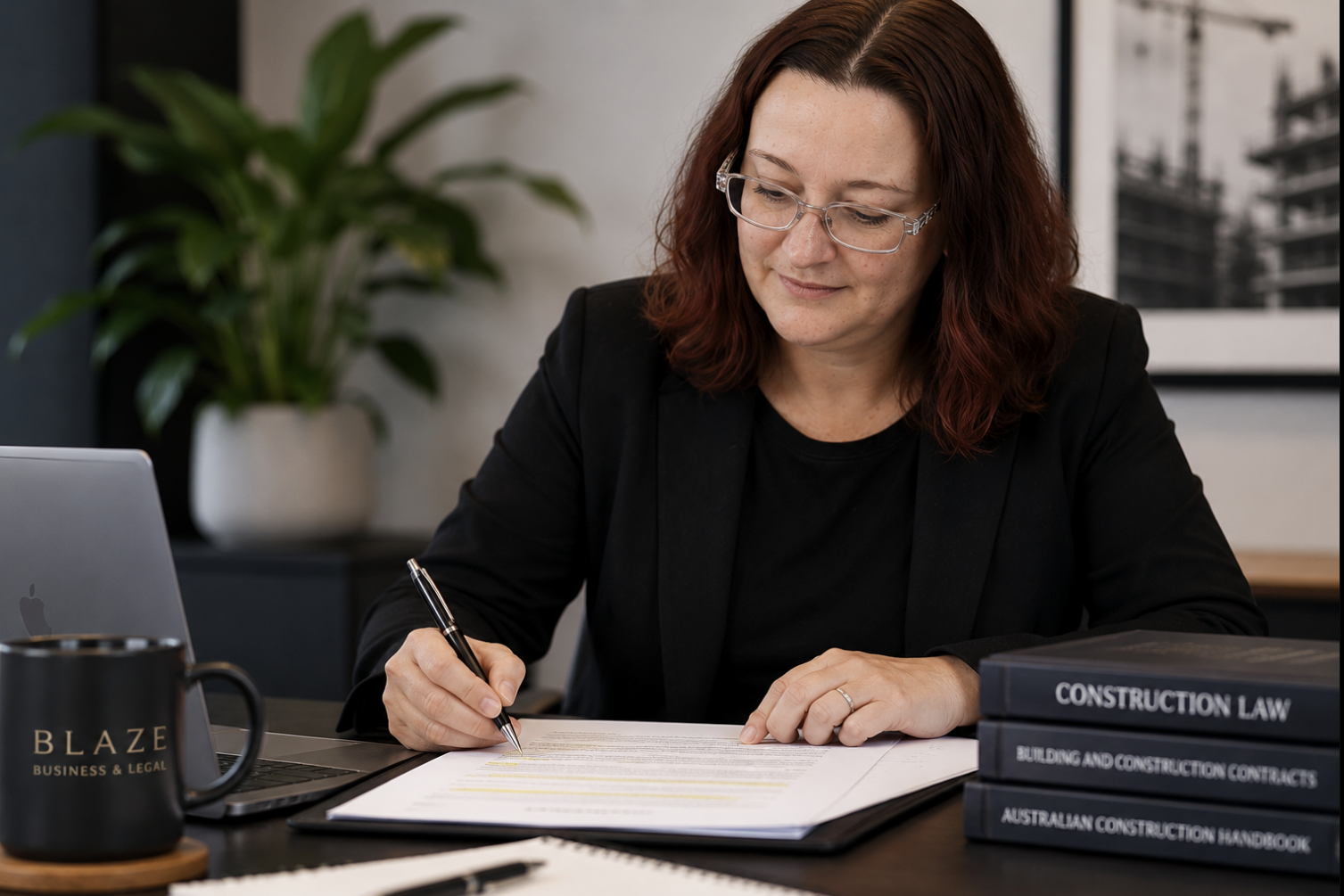
Construction Contracts Drafted For The Way Construction Businesses Work in Real Life
Many construction businesses use contracts that were copied from another project, downloaded years ago or amended so many times that nobody is confident they still protect the business.
A well-drafted Construction Contract should do more than reduce legal risk. It should support the way your business prices work, manages projects, administers contracts, gets paid and deals with problems before they become disputes.
At Blaze Business & Legal, Construction Contract Drafting combines legal advice with practical commercial experience gained from more than 25 years working as a Construction Lawyer, Commercial Manager, General Counsel and Business Adviser. Every contract is drafted around how your business actually operates rather than relying on generic templates.
Whether you need a completely new contract, an existing agreement updated or project-specific clauses drafted, we can prepare practical Construction Contracts for Contractors, Subcontractors and Suppliers across Brisbane and Australia.
Construction Contracts often create commercial problems long before they create legal problems.
“I regularly review contracts that are legally enforceable but are really hard to administer. Notice periods are unrealistic. Variation procedures do not match how your projects run. Payment clauses create unnecessary administration and it takes too long to get paid. Responsibilities are unclear and you’re constantly arguing with your client. When all of that happens, Project Teams start to work around the Contract instead of following it – I know, I’ve been there as Commercial Manager and Deputy Program Manager.” Rachelle Hare, Construction Lawyer, Blaze Business & Legal
A well-drafted contract should make projects easier to manage, not harder. It should clearly allocate risk, support your commercial objectives and give your team practical procedures they can realistically follow throughout the project.
If you already have a contract and want to know whether it is suitable for your next project, our Construction Contract Review service may be the better starting point.
If you need an agreement prepared from the ground up or substantially rewritten, Construction Contract Drafting will likely be the right solution for you – give me a call on (07) 3063 3373 and let’s chat.
What Is Construction Contract Drafting?
Construction Contract Drafting is the process of preparing a legally enforceable agreement that reflects how your construction business actually operates.
For some businesses, that means drafting a completely new contract. For others, it means replacing an outdated template, updating clauses that no longer suit the business or preparing Special Conditions for a particular project. The right approach depends on your existing documents, the type of work you perform and the risks you are trying to manage.
Many construction businesses assume they need a new contract when only parts of their existing agreement need updating. We also see the opposite. A contract may have been copied, amended and reused for years until different clauses no longer work together. The contract still gets signed, but it creates unnecessary administration, confusion and commercial risk on every project.
Construction Contract Drafting should also reflect the practical realities of the projects you deliver. Payment procedures, variation processes, extension of time requirements, notice periods, superintendent powers and subcontract management all affect how your team administers the contract. If those provisions do not match your business, problems often start long before lawyers become involved.
Where an existing contract is generally suitable, updating key provisions may be more cost-effective than starting again. Where the contract no longer reflects your business or exposes you to unnecessary risk, drafting a new agreement often provides a better long-term outcome.
If you already have a contract prepared by another party, our Construction Contract Review service can assess whether it is appropriate before you sign. If negotiations are underway, our Construction Contract Negotiation service can also assist with proposed amendments before the contract is finalised.
When Should A Construction Business Have A Construction Contract Drafted?
Many businesses continue using the same contract because it has “always worked”. In our experience, that usually means nobody has reviewed whether it still reflects the business today. Construction businesses change over time. The contracts they use should change as well.
Construction Contract Drafting is commonly required when:
- starting a new construction business
- moving from residential work into commercial or civil projects
- tendering for larger or more complex projects
- engaging subcontractors under your own agreements
- replacing outdated contract templates
- introducing new project delivery methods
- responding to recurring payment, variation or delay issues
- updating contracts following legislative or insurance changes
- standardising contracts used across different project teams
- reducing unnecessary commercial risk before future projects commence
A common example is a contractor that has grown from a small team into a business delivering larger commercial projects. The contract they used five years ago may no longer deal properly with programming, subcontract management, delay notices, document control or project reporting. The business has changed, but the contract has not.
Another common example is where different Project Managers use different versions of the same agreement. Over time, clauses are added, removed and amended until nobody knows which version represents the business’s preferred position. Standardising those contracts often improves consistency across every project.
Drafting or updating a contract before your next project is usually far easier than trying to resolve the same issues after work has commenced.
Should You Draft A New Construction Contract Or Update Your Existing One?
Many construction businesses assume they need a completely new contract. In many cases, they don’t.
The right answer depends on the quality of your existing contract, how much your business has changed and whether the agreement still reflects the way you deliver projects today.
We regularly review contracts that are fundamentally sound but need several important clauses updated. We also see contracts that have been copied and amended for so many years that starting again is often faster, simpler and more cost-effective than trying to fix them.
A Construction Contract Review is often the best starting point if you’re unsure. We can assess your existing agreement, explain where the commercial and legal risks sit, and recommend whether updating the contract or preparing a new one is likely to deliver the better outcome.
Updating An Existing Construction Contract May Be Suitable If
- your current contract generally works well
- legislation or industry practice has changed
- only particular clauses need updating
- your business has introduced new procedures
- you want to improve risk allocation without replacing the whole agreement
- you need project-specific Special Conditions
Updating an existing contract is often the most cost-effective option where the overall document still reflects your business.
Drafting A New Construction Contract May Be Better If
- your contract was copied from another business
- several different versions are being used across the business
- nobody is confident which clauses still apply
- your business has grown significantly
- your work has moved into different sectors or larger projects
- the contract no longer reflects how your business operates
Starting with a clean document often removes years of inconsistent amendments and gives your business a single contract that can be used confidently across future projects.
Whether we recommend updating an existing agreement or drafting a new Construction Contract, our objective is the same. We want to prepare a contract that protects your business, supports your commercial objectives and is practical for your Project Teams to administer every day.
Drafting or updating a contract before your next project is usually far easier than trying to resolve the same issues after work has commenced. The next question is whether your existing contract can be improved or whether it’s time to start again.
Construction Contract Drafting Services
Every construction business operates differently. A subcontractor working on Tier 1 infrastructure projects faces different contractual risks from a commercial builder, civil contractor or specialist supplier. We draft contracts to suit the work you perform rather than relying on generic templates.
Our Construction Contract Drafting services include:
Construction Contracts
Construction Contracts prepared for Builders, Contractors, Subcontractors, Suppliers and Trade Contractors, tailored to the type of projects you deliver and the commercial risks you want to manage.
Construction Subcontracts
Subcontracts that clearly allocate responsibilities, manage downstream risk and reflect your obligations under the head contract where appropriate.
Consultancy Agreements
Consultancy Agreements for engineers, architects, project managers, superintendents, quantity surveyors and other construction consultants.
Professional Services Agreements
Professional Services Agreements that clearly define the services to be provided, payment arrangements, intellectual property ownership, liability allocation and project responsibilities.
Supply Agreements
Supply Agreements for manufacturers, suppliers and distributors providing construction materials, equipment or specialist products.
Purchase Order Terms And Conditions
Purchase Order Terms and Conditions that create greater consistency across repeat purchasing arrangements and reduce disputes about supply obligations.
Plant Hire Agreements
Plant Hire Agreements covering wet hire, dry hire, responsibilities, insurance, damage, delays and payment obligations.
Labour Hire Agreements
Labour Hire Agreements that clearly define responsibilities between labour hire providers and construction businesses engaging labour on projects.
Special Conditions
Project-specific Special Conditions prepared to amend Australian Standard contracts, client contracts or existing agreements without drafting an entirely new contract.
Clause Drafting
Drafting individual clauses where only particular provisions require updating, including payment, variations, Extension of Time, security, insurance, indemnities and limits of liability, suspension, termination and dispute resolution.
If you already have a contract prepared by another party, our Construction Contract Review service can assess the document before it is signed.
Where negotiations are underway, we can also assist with Construction Contract Negotiation to improve the final commercial outcome.
We also review, advise on and help your team respond to RFTs, RFQs, RFIs and other tender documents.
We Don’t Draft Construction Contracts Without Considering Your Project Delivery
A contract should reflect the way your business actually delivers projects.
Before drafting begins, we take the time to understand the type of work you perform, the clients you work for, the projects you typically deliver and the commercial risks your business is prepared to accept. Those discussions often influence the structure of the agreement just as much as the legal drafting itself.
For example, a contractor that regularly undertakes negotiated work may require different payment provisions from a contractor delivering fixed-price lump sum projects. A subcontractor working under strict head contract flow-down obligations will often need different notice procedures from a specialist consultant engaged directly by a principal.
One of the most common mistakes we see is businesses adopting another company’s contract because it was easily (and cheaply) available. Those contracts usually reflect somebody else’s commercial objectives, project delivery processes and appetite for risk. Over time, they are amended project by project until they become difficult to administer and inconsistent across the business.
Every Construction Contract should support the way your Project Managers, Contract Administrators and Commercial Managers actually perform their work. If the people administering the contract cannot understand it or work out how to comply with it, the document is unlikely to provide the protection it was intended to deliver.
Common Construction Contract Drafting Problems We Regularly See
Most businesses don’t contact us because they want a better contract. They contact us because something has gone wrong on a project, and the contract has not provided the protection they expected.
When we review those agreements, the same issues appear repeatedly. They usually aren’t caused by complicated legal drafting. More often, the contract no longer reflects the way the business operates or the projects it delivers.
The Contract Was Written For Somebody Else’s Business
Many construction businesses start with a contract they inherited from a previous employer, received from another contractor or found online. It may have been suitable for the business that originally used it, but that doesn’t mean it is suitable for yours.
We regularly find contracts containing clauses that nobody in the business understands, obligations that don’t reflect the services being provided and risk allocation that was never consciously accepted. Those issues often remain hidden until a project encounters difficulties.
Nobody Knows Which Version Is The Current Contract
This is one of the most common problems we see. Different Project Managers often save their own version of the same contract. Small amendments are made from project to project until the business ends up using several different agreements without realising it.
That inconsistency means similar projects may be governed by different contractual obligations. It also becomes much harder to train staff, administer contracts consistently and understand the commercial position across the business.
The Contract Doesn’t Match The Way Your Business Operates
A contract should support the way your business delivers projects. We regularly review agreements that require notices to be issued within unrealistic timeframes, approvals that cannot practically be obtained or administrative processes that nobody follows once work begins. When that happens, Project Teams develop their own ways of managing the project instead of complying with the contract.
I’ve seen this from both sides. As a Commercial Manager and Deputy Program Manager, I know the pressure Project Teams work under. If the contract cannot realistically be administered on site, parts of it will eventually be ignored.
Your Business Has Changed But Your Contract Hasn’t
A contract that suited your business five or ten years ago may no longer reflect the work you undertake today. Many construction businesses grow into larger projects, take on more complex procurement models or begin working for different types of clients. Those changes often affect payment procedures, subcontract management, programming obligations, reporting requirements and risk allocation.
If the contract isn’t reviewed as the business evolves, it may expose the business to unnecessary commercial and legal risk.
Small Drafting Issues Often Become Expensive Commercial Problems
Most construction disputes develop because responsibilities were unclear, variation procedures weren’t followed, payment provisions created unnecessary delays or important notices weren’t issued on time. By the time lawyers become involved, those problems have often been affecting the project for months.
Good Construction Contract Drafting won’t eliminate every dispute, but it makes it less likely that many problems arise in the first place.
Why Construction Businesses Choose Blaze Business & Legal For Construction Contract Drafting
Construction Contract Drafting affects far more than the legal relationship between the parties. The way a contract allocates risk, manages variations, deals with payment, sets notice requirements and defines responsibilities will influence how the project is administered from commencement through to final completion.
My approach to drafting has been shaped by much more than practising construction law. Before establishing Blaze Business & Legal, I worked as a Construction Lawyer, Commercial Manager, Deputy Program Manager and General Counsel. Those roles meant I wasn’t simply advising on contracts. I was responsible for administering them, negotiating them, relying on them during live projects and dealing with the commercial consequences when they didn’t work.
That practical experience changes the questions I ask before I start drafting. Rather than simply asking what legal protections you want, I also want to understand how your Project Managers administer contracts, who approves variations, how payment claims are prepared, who negotiates with clients and subcontractors and where problems typically arise during delivery.
We regularly recommend drafting that is simpler rather than more complicated. A clause that nobody understands or consistently follows rarely provides the protection it was intended to achieve. Clear drafting that reflects the way your business actually operates will usually deliver a better commercial outcome than a longer agreement filled with unnecessary provisions.
Construction businesses also appreciate having legal advice and commercial experience in the same conversation. Many contractual issues cannot be viewed in isolation because they affect pricing, procurement, cash flow, project delivery and contract administration. Looking at those issues together often produces a more practical agreement than focusing on the legal drafting alone.
Whether we’re preparing a new agreement or updating an existing one, the objective remains the same. We draft Construction Contracts that are practical to administer, commercially appropriate and aligned with the way your business delivers projects.
Our Construction Contract Drafting Process
Every Construction Contract starts with a discussion about your business rather than opening a precedent document. That initial conversation often determines the structure of the agreement because it helps us understand the commercial objectives the contract is intended to support.
1. We Learn About Your Business
Before drafting begins, we’ll discuss the type of work you perform, the projects you deliver, the clients you work for and the commercial risks your business is prepared to accept. If you already use contracts, we’ll also review what is working well and where problems regularly occur.
2. We Review Your Existing Documents
Existing contracts, purchase orders, Special Conditions and client agreements often provide useful context. Understanding how those documents are currently being used helps us determine whether they should be updated or replaced.
Where appropriate, we may recommend a Construction Contract Review before drafting commences, particularly where substantial amendments have been made over many years.
3. We Prepare Your Draft Agreement
Your contract is drafted specifically for your business rather than adapted from a generic template. Throughout the drafting process, we consider how the document will operate during procurement, contract administration, payment, project delivery and close-out.
4. We Discuss The Draft With You
Once the draft has been prepared, we’ll walk you through the key provisions, explain the commercial reasons behind important clauses and answer any questions before the document is finalised.
Construction Contracts should support the way your business operates. We want you to understand why provisions have been included, not simply receive a document that sits on a shelf until the next project starts.
5. We Finalise Your Construction Contract
Following your feedback, we’ll prepare the final agreement ready for use on future projects. Where requested, we can also prepare supporting documents such as Purchase Order Terms and Conditions, Special Conditions, subcontract templates and other related construction agreements to create greater consistency across your business.
How Much Does Construction Contract Drafting Cost?
Every Construction Contract is different, so it’s difficult to provide a single price that applies to every project.
Drafting a straightforward subcontract from an established precedent is very different from preparing an entire suite of contracts for a growing construction business. The time involved depends on the type of agreement, the complexity of the project, whether existing documents can be used as a starting point and the level of customisation required.
Where possible, we provide fixed-fee pricing before work begins so you know exactly what the work will cost. If the scope changes during the engagement, we’ll discuss that with you before carrying out any additional work.
If you’re unsure whether you need a new contract or an existing agreement updated, we’ll discuss the options with you before providing a fixed-price proposal.
Why Investing In Good Construction Contract Drafting Often Costs Less
Construction businesses don’t usually lose money because a contract contains one catastrophic clause. More often, profit is lost through dozens of small issues that occur throughout the project.
A poorly drafted variation procedure may delay payment for months. Unclear programming obligations may increase administration. Contract notices may not be issued when they should be. Project teams spend time arguing about responsibilities instead of delivering the work.
We regularly see businesses spend far more managing avoidable contract issues than they would have spent preparing an agreement that reflected the way they actually operate.
A well-drafted Construction Contract is an investment in future projects, not just the next one. Once the agreement has been prepared, it can usually be adapted for future work, reviewed periodically and updated as your business continues to grow.
Related Construction Contract Services
Construction Contract Drafting is often only one part of the support construction businesses require. Depending on your circumstances, you may also benefit from:
- Construction Contract Review if another party has prepared the agreement and you want independent legal advice before signing.
- Construction Contract Negotiation if contract terms are still being negotiated and you want assistance improving your commercial position.
- Schedule of Departures where proposed amendments need to be clearly documented and presented to the other party.
- Construction Contract Mark-Up if you would like amendments prepared directly in the draft contract.
- Construction Lawyer Brisbane if you require ongoing legal and commercial support across multiple projects.
- Commercial Contract Review where the agreement is not construction-specific but still requires legal review.
Many clients engage us for one of these services initially before asking us to prepare standard contracts for future projects.
FAQs About Construction Contract Drafting
1. What Is Construction Contract Drafting?
Construction Contract Drafting involves preparing a legally enforceable agreement that reflects the way your construction business operates and the commercial risks you want to manage. A well-drafted contract should clearly allocate responsibilities, establish practical procedures for administering the project and deal with issues such as payment, variations, Extensions of Time, insurance, defects, termination and dispute resolution before work begins.
2. What Types Of Construction Contracts Can Blaze Business & Legal Draft?
Construction Contract Drafting services include Construction Contracts, Construction Subcontracts, Consultancy Agreements, Professional Services Agreements, Supply Agreements, Plant Hire Agreements, Labour Hire Agreements, Purchase Order Terms and Conditions, Special Conditions and project-specific contractual documents. We also draft individual clauses where an existing agreement only requires targeted amendments rather than a complete rewrite.
3. Should I Draft A New Construction Contract Or Update My Existing Contract?
Whether a new Construction Contract should be drafted or an existing agreement updated depends on the quality of your current contract and whether it still reflects the way your business operates. Many agreements only require selected clauses to be modernised, while others have been amended so many times that preparing a new contract provides a simpler and more consistent long-term solution.
4. Can An Existing Construction Contract Be Updated Instead Of Drafting A New One?
Updating an existing Construction Contract is often the most practical option where the overall agreement remains suitable for your business. Common updates include payment provisions, variation procedures, notice requirements, risk allocation, legislative references and Special Conditions so the contract better reflects current law and your commercial objectives.
5. How Are Construction Subcontracts Different From Head Contracts?
Construction Subcontracts differ from Head Contracts because they need to manage the relationship between the Contractor and Subcontractor while also considering obligations flowing down from the upstream contract. A well-drafted subcontract should protect your business without creating inconsistencies that make the project more difficult to administer.
6. When Should An Australian Standard Construction Contract Be Used?
Australian Standard Construction Contracts provide a recognised starting point for many projects, but they are not automatically suitable for every construction business or every procurement model. Many clients use Australian Standard contracts together with carefully drafted Special Conditions, while others are better served by a bespoke agreement prepared specifically for the way they deliver projects.
7. What Are The Risks Of Using AI To Draft A Construction Contract?
Using AI to draft a Construction Contract may produce a document that appears comprehensive but does not reflect your commercial objectives, project delivery processes or appetite for risk. AI can assist with drafting tasks, but it cannot replace legal judgement or practical construction experience when deciding how contractual risk should be allocated between the parties.
8. How Long Does Construction Contract Drafting Usually Take?
The time required for Construction Contract Drafting depends on the type of agreement, its complexity, the level of customisation required and whether existing documents can be used as a starting point. Updating an existing contract is often completed more quickly than preparing an entirely new agreement, and we’ll discuss expected timeframes before work commences.
9. How Much Does Construction Contract Drafting Cost?
The cost of Construction Contract Drafting depends on the type of agreement, the complexity of the project, the level of customisation required and whether you’re updating an existing contract or preparing a new one. Wherever possible, we provide fixed-fee pricing so you know the cost before work begins.
10. What Information Is Needed Before Drafting A Construction Contract?
Preparing a Construction Contract usually starts with understanding your business, the projects you undertake, the clients you work for and the commercial risks you want the contract to address. Reviewing your existing contracts, purchase orders, Special Conditions or client agreements also helps us prepare a document that better reflects the way your business operates.
11. Can Blaze Business & Legal Draft Construction Contracts For Businesses Outside Brisbane?
Construction Contract Drafting services are available for construction businesses throughout Brisbane, Queensland and Australia. Many of our clients operate across multiple states, and we regularly prepare agreements for projects taking place well beyond South East Queensland.
12. What Is The Difference Between Construction Contract Drafting And Construction Contract Review?
The difference between Construction Contract Drafting and Construction Contract Review is that drafting involves preparing a new agreement or substantially rewriting an existing one, while a Construction Contract Review assesses a contract that has already been prepared and identifies the legal and commercial risks before it is signed. Many businesses begin with a Construction Contract Review before deciding whether their existing agreement should be updated or replaced.
Speak With A Construction Contract Drafting Lawyer
Every construction business works differently. The contract you use should reflect the projects you deliver, the commercial risks you’re prepared to accept and the way your team administers contracts from tender through to final completion.
Whether you need a new Construction Contract, a subcontract, Special Conditions or an existing agreement updated, we’d be pleased to discuss your requirements and provide a fixed-price proposal.
Call Rachelle Hare on (07) 3063 3373 or request a fixed-price quote to discuss your Construction Contract Drafting requirements.