Management Consulting - A Straightforward Guide

Blaze Business & Legal » Management Consulting – A Straightforward Guide for Australian Business Owners

Management Consulting – A Straightforward Guide for Australian Business Owners

Management Consulting helps businesses put the right internal systems in place to support sustainable growth, manage risk, and improve performance. For SMEs, it often involves fixing structural gaps, implementing legally enforceable documentation, and giving owners the clarity to lead without being pulled into daily operations. This Guide explores what Management Consulting means in practice, what outcomes it delivers, and how it supports long-term business health.

Key Takeaways

  • Management Consulting is about improving internal structure, compliance and systems

  • A Management Consultant delivers documentation, policy, and operational tools – not just advice

  • SMEs benefit most from consultants who install usable systems, not theoretical strategies

  • Fixed-fee engagements with clear deliverables are preferred over open-ended consulting

  • Blaze Business & Legal delivers legal-backed consulting systems for SMEs across Australia

  • Real client experiences show how Management Consulting creates clarity, reduces stress, and improves business performance

What Is Management Consulting?

Management Consulting refers to a structured professional service that improves the way a business operates. It typically focuses on internal systems – including contracts, onboarding, delegation, risk management, governance, compliance and performance frameworks.

For small and medium businesses, the most useful form of Management Consulting doesn’t come in the form of a report or a slide deck. It comes in the form of documentation and systems that can be used immediately.

A Management Consultant working with SMEs helps clarify how the business operates day-to-day, who is responsible for what, and what legal and compliance risks may be going unaddressed. The focus is not on theory. It’s on action.

Business professionals having a meeting in a conference room. Management Consulting

How Management Consulting Supports Business Growth

A business can only grow as far as its systems will allow. Without structure, growth leads to confusion, inconsistency and legal risk. A Management Consultant supports growth by installing the systems that hold the business together as it expands.

These systems include:

  • Employment and contractor agreements

  • Staff policies (leave, WHS, privacy, performance, complaints)

  • Onboarding and induction documentation

  • Delegation and decision-making frameworks

  • Internal governance and reporting tools

Growth becomes scalable when the business no longer depends on memory, legacy knowledge or informal handovers. Clear systems allow new people to join, leaders to delegate, and directors to focus on strategy rather than fixing mistakes.

Businesswoman talking to management consultant. Management. Consulting. Management Consulting Professional

Types of Management Consulting Services

There are different types of Management Consultants, each specialising in different outcomes.

Strategy Consultants focus on positioning, forecasting, business planning and competitive insights. They’re often suited to large businesses or those seeking investment. They rarely address compliance or operational structure.

Operations Consultants typically focus on improving workflows, processes or systems integration. They can be valuable where tech, logistics or automation is central – but may miss the compliance or people-side of the business.

Risk and Compliance Consultants specialise in specific areas such as WHS, licensing or regulatory obligations. They often provide reports, templates or checklists but don’t typically implement legal systems or enforceable frameworks.

SME-Focused Management Consultants like Blaze Business & Legal provide integrated operational and legal systems. This includes drafting contracts, building policy frameworks, creating role and responsibility documents, and delivering tools that the business owns outright.

These SME-focused engagements are the most practical for small and growing businesses that need implementation, not just advice.

Business people collaborating ideas. Management Consulting

Common Problems a Management Consultant Solves

A good Management Consultant identifies not only the issues the business can see – but the ones it hasn’t recognised.

Common problems include:

  • Lack of enforceable employment or contractor agreements

  • No formal onboarding or staff induction process

  • Staff performing outside of scope with no clear role documentation

  • Delegation decisions made inconsistently

  • Leaders unable to step away from daily operations

  • Compliance risk due to missing or outdated policies

  • Informal performance or complaints handling

  • Unstructured leadership or governance meetings

A Brisbane-based physiotherapy clinic came to Blaze Business & Legal after expanding to a second location. They had hired new staff but were still using outdated contracts and verbal onboarding. The founder was spending most of her time solving internal issues. Within 10 weeks, the business had enforceable contracts, policy frameworks, onboarding documentation and a clear delegation chart. She now leads the business instead of managing the daily chaos.

Solicitor Brisbane and client reviewing a contract. Management Consulting. Solicitor Brisbane

When to Engage a Management Consultant

Most SMEs wait too long. They engage a Management Consultant only after a complaint, a Fair Work claim, or when internal performance has already slipped. But early engagement allows you to prevent those issues entirely.

Good times to engage include:

  • Before hiring more staff

  • After a complaint or internal dispute

  • When roles and responsibilities start overlapping

  • When you feel like the business is outgrowing its systems

  • Before a licensing, accreditation or investment process

  • When the director is spending more time managing people than leading the business

In one case, a boutique digital agency with 12 staff engaged Blaze Business & Legal after several high-performers resigned citing internal confusion and lack of support. The business had strong client work but weak structure. Contracts were inconsistent. Policies were missing. New hires were onboarded verbally. Within two months, we delivered contracts, policies, delegation tools and onboarding systems. The director now spends 80% of his time on clients – not admin.

Business professionals having a discussion with a consultant. Management Consulting

What a Management Consultant Actually Delivers

A Management Consultant isn’t there to coach or motivate. They’re there to fix the structural issues holding your business back.

Deliverables include:

  • Legally compliant employment and contractor agreements

  • Staff handbooks and policies

  • Onboarding templates and induction schedules

  • Privacy, WHS, leave and complaints frameworks

  • Delegation charts and role responsibilities

  • Meeting structures, agendas and board reporting

  • Risk registers and escalation frameworks

  • Custom implementation guides for each tool

All of these are delivered under a fixed fee and scoped engagement. You know exactly what is being done, and the work is completed in a way that allows your team to own and operate the system without ongoing reliance on the consultant.

Woman leading a meeting. Management Consulting

The Role of Legal and Compliance in Consulting

Legal systems are often neglected in traditional Management Consulting. However, for businesses operating under the Fair Work Act, Privacy Act and WHS obligations, enforceable documentation isn’t optional.

Blaze Business & Legal is a hybrid Management Consultant and legal provider. That means every agreement, policy or system we install is backed by law and fit for real-world use.

A Sunshine Coast naturopathy clinic engaged Blaze Business & Legal after experiencing inconsistent client care, staff miscommunication, and a rising risk profile. They had never documented roles or expectations. We delivered contracts, scope of services, onboarding tools and a fully enforceable complaints framework. When the clinic was later audited by its professional association, it passed with no further action.

Management Consultant delivers a presentation to her clients. Management Consulting

Fixed-Fee vs Hourly Consulting Models

Many traditional Management Consultants charge by the hour. This creates uncertainty for clients, leads to scope creep, and often discourages practical implementation.

Blaze Business & Legal uses a fixed-fee model. Each engagement includes a defined scope, clear deliverables, and timeframes. You know what you’re paying for before we start. No time billing. No open-ended meetings. Just outcomes.

For SMEs that need certainty, a fixed-fee engagement offers commercial predictability and outcome accountability.

Management Consultant and clients holding a meeting. Management Consulting

Management Consulting for SMEs vs Large Enterprises

SMEs operate differently from corporates. They have smaller teams, flatter hierarchies and limited bandwidth for theory.

That’s why Management Consulting for SMEs needs to be lean, practical and immediately usable.

SMEs need:

  • Short implementation timeframes

  • Low-maintenance systems

  • Clear role documentation

  • Staff policies tailored to their sector

  • Enforceable contracts without legal ambiguity

  • Tools that don’t require a full HR department to run

That’s exactly what Blaze Business & Legal delivers.

Businessman and women gathered for a business meeting. Management Consulting

Building Systems That Last Beyond the Engagement

A key test of any Management Consulting project is whether the systems survive the departure of the consultant.

At Blaze Business & Legal, we write your documents so you can own them. We train your team to use them. And we ensure the system is simple enough to operate internally without our ongoing involvement.

When needed, we return for a quarterly review, a governance refresh or a compliance update — but not to prop up the same problem we were engaged to solve.

Management Consultant consulting with clients. Management Consulting

Management Consulting and Internal Governance

Governance isn’t just for corporates. Every business with a team, directors, decision-making obligations or compliance exposure needs internal governance. Management Consulting helps businesses define, document and follow a governance model that matches their size, risk and structure.

Governance includes:

  • Regular leadership meetings with documented outcomes

  • Clear agendas that include compliance, performance and risk

  • Delegated responsibilities with accountability timelines

  • Documentation of who can approve what, and under what circumstances

  • Processes for complaint handling and escalation

  • Reporting systems that support decision-making

Many SMEs think they’re too small for governance. But lack of governance is why directors stay stuck in daily operations, why compliance is missed, and why decisions are made emotionally instead of strategically.

Blaze Business & Legal helps install lean, enforceable governance systems that reduce founder dependency and improve business health.

Three business professionals engaged in a conversation. Management Consulting. Management Consulting Professionals

Real-World Example: Client Success Story with Blaze Business & Legal

A multi-site health services provider approached Blaze Business & Legal after experiencing a string of staff complaints, inconsistent service delivery and increased client churn. The business had grown from a single clinic to three locations in under two years, but its internal structure hadn’t kept up.

There were no onboarding documents. Each clinic had its own way of doing things. Staff were frustrated with inconsistent policies and unclear expectations. The director was working across all sites daily just to keep things afloat.

Blaze Business & Legal delivered:

  • One set of employment agreements for all locations

  • A unified onboarding and induction pack

  • Policies covering leave, performance, privacy and WHS

  • Delegation and leadership charts for each clinic

  • A shared governance structure for reporting and compliance

Twelve weeks later, complaints had dropped. Team feedback had improved. The director was attending meetings, not handling admin. And the business was finally running as one organisation – not three disconnected locations.

Business Team in a meeting. Management Consulting

Scenario: Business Without Structure

A boutique creative agency has 14 staff and a growing client list. The work is good. The team is talented. But the owner is overwhelmed.

There are no staff policies. Two team members are unsure who they report to. One contractor has never signed an agreement. The last onboarding was done verbally. Complaints are handled informally, if at all.

One mistake with a client triggers an internal argument. A key staff member resigns. The director finds herself redoing the work and apologising to the client.

She knows something is wrong – but doesn’t know where to start.

This is a typical starting point for engaging a Management Consultant.

Blaze Business & Legal would:

  • Audit the current structure

  • Create a scoped engagement to install contracts, policies and onboarding tools

  • Deliver a delegation and reporting framework

  • Establish a performance and complaints process

  • Train the team on how to use the systems independently

By fixing the structure, the business moves from reactive to proactive. The owner gets time back. The team gains clarity. And client service improves without burnout.

Consultant and business professionals engaged in a meeting. Management Consulting

How Blaze Business & Legal Delivers Its Services

Blaze Business & Legal doesn’t operate like a traditional consulting firm. We don’t bill by the hour. We don’t write reports you won’t read. We don’t leave you with templates that don’t apply to your business.

We work under a clear and commercial model:

  1. Scoping or Business Pulse Check – We assess where your systems are now

  2. Fixed-Fee Proposal – You receive a scope, deliverables list, price and timeline

  3. Documentation and Implementation – We draft everything. You get ownership

  4. Handover and Support – We show you how to use it. You stay in control

Everything is legally sound, commercially tailored, and built for usability.

Our clients are located across Australia. We work remotely or in person depending on your needs and the size of the engagement. All work is delivered with commercial clarity and practical systems you can run yourself.

Board room meeting. Management Consulting

Choosing the Right Consultant for Your Business

Not all Management Consultants are right for your business. You need someone who understands:

  • The way SMEs actually operate

  • Legal requirements for contracts, policies and governance

  • The need for simple systems, not bloated frameworks

  • That you don’t have time to waste on theory or waffle

Look for a Management Consultant who:

  • Offers fixed-fee delivery

  • Gives you ownership of the tools they build

  • Provides practical documents, not just strategy decks

  • Tailors the engagement to your size, staff, structure and sector

  • Has experience helping businesses like yours

If they can’t explain what they’ll deliver or how it will protect your business – keep looking.

Three business people in the office working. Management Consulting

Checklist: Are You Ready for a Consultant?

You may be ready to engage a Management Consultant if:

  • You’re growing but don’t have the structure to support it

  • You’re reacting to problems instead of preventing them

  • Staff are unclear on their roles or responsibilities

  • You’ve had a complaint or legal issue in the last 12 months

  • You’re hiring or onboarding new staff without consistent documentation

  • Your contracts or policies are outdated or missing

  • You want to step back from operations but can’t

  • You’re unsure if your current systems are legally compliant

Even if you’re not ready for a full engagement, a Business Pulse Check can give you clarity.

Client and Management Consultant having a conversation. Management Consulting

Conclusion

Management Consulting for SMEs isn’t about theory. It’s about structure. A good Management Consultant doesn’t give you ideas. They give you systems – documented, enforceable, usable systems that reduce risk, improve clarity and support growth.

If your business feels messy, reactive or exposed, it’s time to get serious about your structure.

Blaze Business & Legal works with SMEs across Australia to deliver legal-backed consulting systems under fixed-fee engagements.

Get in touch with us to learn how we can help your business.

Business team gathered in the office. Management Consulting. How to Protect your Business

FAQs

1. What is Management Consulting in simple terms?

Management Consulting is the process of improving a business’s internal systems, compliance, and operational structure. A Management Consultant helps owners create clarity across staffing, documentation, risk and decision-making so the business can scale without chaos.

2. How do I know if I need a Management Consultant?

You can determine if you need a Management Consultant by reviewing whether your internal systems are supporting or restricting your business. If you’re facing performance issues, unclear delegation, contract risks or complaints, then Management Consulting can help address the gaps.

3. What does a Management Consultant actually do for small businesses?

A Management Consultant for small businesses helps install enforceable contracts, practical onboarding tools, compliance frameworks and operational policies. This work supports owners to delegate, manage risk and run the business more efficiently.

4. What makes Blaze Business & Legal different from other Management Consulting firms?

Blaze Business & Legal stands out by combining legal expertise with Management Consulting for SMEs. Every policy, agreement and system we install is tailored, enforceable and designed to work in a real business – not just in theory.

5. Are there legal risks if I don’t have formal staff systems in place?

There are significant legal risks if your business lacks formal staff systems such as employment contracts, policies and complaints procedures. A Management Consultant can reduce Fair Work and WHS exposure by implementing enforceable documentation that meets Australian legal standards.

6. How long does a Management Consulting engagement usually take?

A Management Consulting engagement typically runs between 6 to 12 weeks, depending on the size and complexity of the business. Blaze Business & Legal delivers fixed-fee, scoped projects with set timelines and a clear deliverables list.

7. What industries benefit most from Management Consulting?

Industries that benefit most from Management Consulting include healthcare, professional services, construction, education and digital agencies. Any sector with staff, compliance obligations and growth ambitions can improve performance with internal systems support.

8. Can a Management Consultant help with delegation and team accountability?

A Management Consultant can help with delegation and team accountability by clarifying roles, setting up decision-making frameworks and documenting responsibilities. These tools help prevent decision bottlenecks and improve staff alignment.

9. Is Management Consulting only for large businesses?

Management Consulting is not only for large businesses – SMEs often benefit more because they typically lack internal HR, legal or operations staff. Tailored systems from a Management Consultant can solve problems early and support sustainable growth.

10. What kind of policies does a Management Consultant help implement?

A Management Consultant helps implement staff policies including leave, performance management, privacy, WHS, bullying and complaints handling. These policies reduce business risk and clarify expectations for staff and contractors.

11. Can Management Consulting help with performance issues and staff complaints?

Management Consulting can support performance and complaints handling by installing formal processes that meet legal and operational standards. These systems help ensure fair treatment, reduce liability and protect business reputation.

12. What’s the difference between a Management Consultant and a business coach?

The difference between a Management Consultant and a business coach is that a consultant installs systems while a coach provides guidance and motivation. Blaze Business & Legal delivers documents, processes and compliance tools that businesses can use independently.

13. How do I get started with Management Consulting at Blaze Business & Legal?

You can get started with Management Consulting at Blaze Business & Legal by booking a free 30 minute Strategy Session or requesting a fixed-fee proposal. Our process includes scoping, delivery and training so you receive systems that are ready to use.

Threebusiness individuals gathered around an office table. Management Consulting

Read our Related Articles

Management Consulting

Business Management Consulting

Improving Your Business

Small Business Management Consulting

Business Strategy

Case Studies

Case Study: How an $85k Business Coach Failed This Construction Company (and How We Fixed It)

Blaze Business & Legal

Ready to Take the Next Step?

Claim your FREE Structure Diagram or engage Blaze Business & Legal for a full structure analysis + help getting compliant

Use our unique StructureSAFE app to map your company structure and generate your free structure diagram, or apply for Blaze Business & Legal’s Comprehensive Business Structure Analysis if you need detailed legal and structural advice.

Blaze Business & Legal Logo - Structuring your construction business
Table of Contents

Send Us A Message

Blaze Business & Legal

StructureSAFE

Need help understanding your business structure?

Get your FREE Structure Diagram with our StructureSAFE app, or engage Blaze Business & Legal for a full Structure Analysis + help getting compliant.

Testimonials

“My construction business was slipping until a mate told us about Blaze Business & Legal. Now we’re kicking major goals!”

J. P. – Sunshine Coast Excavation Company

___

“We haven’t met any other lawyer or adviser who understands business structuring the way Rachelle Hare and Shannon Drew do.

Blaze Business & Legal fills a gap that business owners like me often don’t know is there. Accountants do our tax, lawyers draft a document if you ask for it, and banks expect your structure to be sorted before they will lend.

Rachelle and Shannon stepped back and looked at the whole structure of my business. They saw where things didn’t line up properly. They pointed out the risks. And they showed me how the structure was holding my business back from growing and getting a bank to lend us money. Then they worked with me and my Accountant to straighten it all out.”

Steve M, Civil Construction Owner, Brisbane

State of the Australian Construction Industry 2026 | Blaze Business & Legal
For construction business owners and executives across Australia: the industry intelligence you need

State of the Australian Construction Industry

Expert voices, industry data and ground-level intelligence on the pressures reshaping construction in 2026

April 2026 Written and compiled by Rachelle Hare Reviewed by Shannon Drew
Are you in the construction industry? We want to hear what you are seeing on the ground. All contributors credited and linked.
Email your contribution to this Report →

What Is Happening to Australian Construction

The Australian construction industry entered 2026 already under pressure. Labour costs, material prices, insurance premiums and compliance burdens had been rising steadily. Builders were operating on margins that left almost no room for the unexpected.

Then the Iran conflict closed the Strait of Hormuz. Diesel surged. Fuel costs that were already embedded in every quoted price, every purchase order and every subcontract became a moving target overnight. Contracts locked in months ago at prices that assumed a stable cost environment are now being delivered in conditions those contracts were never designed to handle. The consequences are landing across the entire supply chain: delayed projects, disputed invoices, suppliers applying levies mid-job, and businesses that cannot complete what they have already started without absorbing losses they were never asked to price.

The voices collected here represent builders, lawyers, accountants, consultants, insolvency practitioners, civil contractors, peak bodies, industry bodies and commentators across Australia.

36%
Diesel price rise in two weeks following Iran conflict escalation
BuiltGrid, April 2026
5.8%
Construction insolvency rate, above the national average
BuiltGrid, April 2026
7%
Annual construction cost growth before this crisis, nearly double general inflation
BuiltGrid, April 2026
30.8%
Build cost increase that followed the COVID supply shock
BuiltGrid, April 2026
79%
Of civil construction energy that comes from diesel
Civil Contractors Federation Australia, April 2026
~90%
Of Australia's oil that is imported
SBS News, March 2026
Section 1

Financial Pressure and the Fuel Shock

The construction industry in Australia entered 2026 already absorbing multiple simultaneous cost pressures. Shannon Drew, Management Accountant and Fractional CFO at Blaze Business & Legal, has modelled the combined impact of six simultaneous cost inputs across client portfolios. The finding is consistent, in that the total uncontracted cost impact of the current fuel crisis on active projects is two to three times higher than the direct diesel number. What Shannon has found is that a business which has calculated its diesel exposure at $180,000 often finds its full-portfolio exposure increased to $395,000 by the time it takes these other five cost impacts into account. Shannon has written a full analysis of the financial impact of the construction cost crisis on project margins →

Industry Data

Australian industry conditions declined materially in March, with the Australian Industry Index falling 19.9 points to -23.6, the steepest monthly fall since the initial pandemic phase of early 2020. Uncertainty was the main factor, with 30% of businesses reporting volatility in fuel prices, freight and supply arrangements. More than a quarter said rising costs were a major pressure across fuel, freight, raw materials, resins, plastics and packaging.

Australian Industry GroupAustralian Industry Index, March 2026
Peak Body

Construction, and civil in particular, is the most reliant Australian industry on diesel, contributing 79% of our energy. Civil Contractors Federation Australia has spoken to governments and national and state media about the rise in costs and the contract flexibility needed to work through the energy shock. Minimising price rises in maintenance and replacement costs of civil infrastructure requires the government working closely with the civil sector in the period ahead.

Nicholas ProudCEO, Civil Contractors Federation Australia
2 April 2026ccf.com.au
Contractor

Diesel hit $3 a litre last week. We've got lump sum contracts locked in, purchase orders issued, and now suppliers are adding fuel levies or pushing back on supply unless prices move. Every path from here costs someone money that wasn't in the original deal.

Tim BuckleConstruction Contractor, Australia
2 April 2026LinkedIn
Civil Contractor

For regional and civil contractors, the compounding effect is the biggest concern: fuel costs hit transport first, then materials, then every other input. There is no way to swap diesel out. It is what moves everything.

Colm PhibbsCivil Construction, Regional Australia
2 April 2026LinkedIn
Developer

In recent weeks we have engaged with our supply chain, consultants and subcontractors to understand the real cost impact hitting active and pipeline projects. The picture is not uniform, but the direction is consistent, and the pace is faster than anything we saw coming out of COVID.

Wayne AzzopardiHead of Urban Projects, Orion Group Construction and Infrastructure
4 April 2026LinkedIn
Parliament

A national reef operator in Far North Queensland will see fuel expenses increase by $1 million dollars from February to end of financial year in June. Fuel shortages and fuel costs are impacting farmers, the tourism industry, and regional communities and small business owners. One in seven people in Far North Queensland are employed by tourism.

Bree James MPMember for Barron River, Queensland Parliament
Blaze Business & Legal

Our phones have rung off the hook this week. We have had a flood of enquiries from builders wanting to introduce cost-escalation clauses, and from homeowners seeking advice because some builders are now trying to cancel contracts that were only just signed. If they make the wrong move, the consequences can be significant. The smartest thing anyone in the industry can do is slow down, understand their legal position, and avoid making reactive decisions under pressure.

Rachelle HareBusiness Adviser, specialist Construction Lawyer and Managing Director, Blaze Business & Legal
Media

Australia imports roughly 90 per cent of its oil, and the country's refinery count has fallen from eight to just two. The shift has left Australia increasingly exposed to global energy shocks. Energy Minister Chris Bowen confirmed six oil shipments bound for Australia in April were turned back or deferred due to escalating tensions. The government has alluded to a "national crisis."

SBS NewsFuel Supply Analysis, Australia
22 March 2026sbs.com.au
Analysis

$9 per litre diesel by July? Sounds ridiculous until you actually run the numbers. Australia runs on diesel. We've got 20 to 26 days of supply. We import 90%, refined in Asia, but the supply chain runs through the Middle East for around 48%. We are at the very end of that chain. With flows constrained at 25%, that is where pricing breaks. With flows stalled, you are looking at a 60-plus per cent shortfall, and fast. That is not expensive fuel anymore. That is access. Industries start to slow, or stop.

Marcus ZeltzerConstruction and Infrastructure Adviser, Australia
4 April 2026LinkedIn
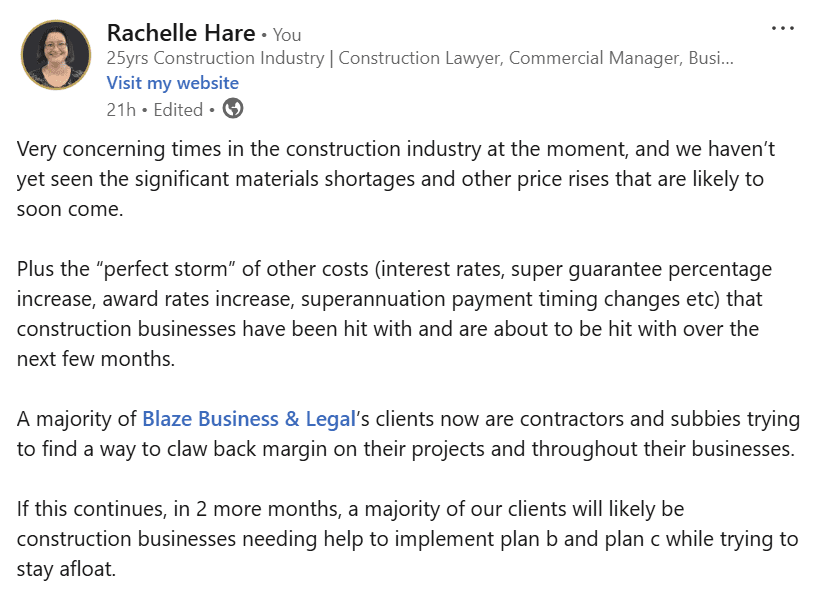
Rachelle Hare LinkedIn post April 2026 on the construction industry fuel crisis
Policy Analysis

The current fuel security issue was entirely predictable and, in fact, comprehensively predicted. No recent Australian government can say it was not warned. The "fair-weather" approach that plagues Australia's fuel security could not contrast more starkly with the concerted action directed towards critical minerals. The 2014-15 senate inquiry into Australia's transport energy resilience examined the very issues in which the country is currently mired.

Brent JacksonLowy Institute
19 March 2026lowyinstitute.org

"The global shocks we have been hit with this decade are not passing storms. They are extremes of a more volatile economic climate."

Jon Davies, referencing the Prime Minister's address to the National Press Club • LinkedIn, April 2026
Section 2

Material Costs and Supply Chain Disruption

Fuel is the headline. Materials are where the damage compounds. The Reece Group notifications, cement surcharges and trucking levies represent confirmed, enforceable cost increases arriving mid-project on budgets that never included them. For businesses on fixed-price contracts, each of these increases transfers directly to margin.

Supply chains built on just-in-time delivery and imported product have nowhere to absorb consecutive shocks. The businesses most exposed are those with no forward procurement, no supplier agreements locking in prices, and no visibility into their cost-to-complete across the full project portfolio.

We have written a detailed guide to rising construction costs in Australia and what businesses can do about them →

Media

National average unleaded petrol reached 219.5 cents per litre for the week ending 15 March, up from around 169 cents before the conflict intensified. Diesel climbed to 245.6 cents per litre, with isolated reports of $3 per litre in parts of Sydney's northern beaches. The surge ranks among the sharpest in the developed world, per GlobalPetrolPrices data.

International Business Times AustraliaFuel Crisis Coverage
22 March 2026ibtimes.com.au
Industry Data

Diesel is up 36 per cent in two weeks. Petrol is up 30 per cent. Reece Group has notified customers of price increases of up to 36 per cent on HDPE pipe, 31 per cent on stormwater drainage products, and 28.5 per cent on PVC from 18 April. Cement is up 15 per cent on imports, 10 per cent on local manufacturing, with trucking adding another 12 to 15 per cent on top. CreditorWatch is already warning of another wave of insolvencies across construction, road freight, and every sector in between.

BuiltGridConstruction Supply Chain Platform, Australia
1 April 2026builtgrid.com
Legal

From where I sit advising on contracts and commercial risk, the real exposure for construction, mining and defence lies in the wider logistics and production ecosystem: urea, ammonium nitrate, industrial chemicals and other inputs that keep transport, earthworks, explosives and agriculture moving. Once those start to bite, the pressure shows up quickly in food prices, basic household needs, and wage and CPI expectations.

Kirsten DilenaGeneral Counsel and Commercial Director, DLC Legal (Construction, Mining and Defence), QLD
22 March 2026dlclegal.com.au
Blaze Business & Legal

One of our SME transport clients is now spending an additional $10,000 per week on fuel costs for their trucks. That is not an annualised forecast. That is the cash flow hit landing in a single week. For businesses operating on thin margins with fixed-price commitments, there is no buffer. The question is whether the financial controls are in place to see the problem clearly before it becomes a solvency event.

Shannon DrewManagement Accountant, Costs Accountant, Fractional CFO and Business Adviser, Blaze Business & Legal
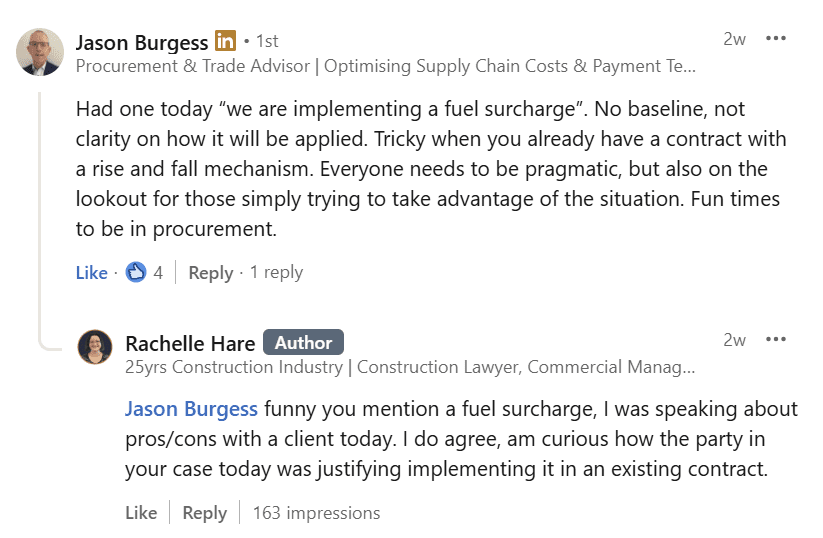
Jason Burgess LinkedIn comment on the fuel crisis and construction
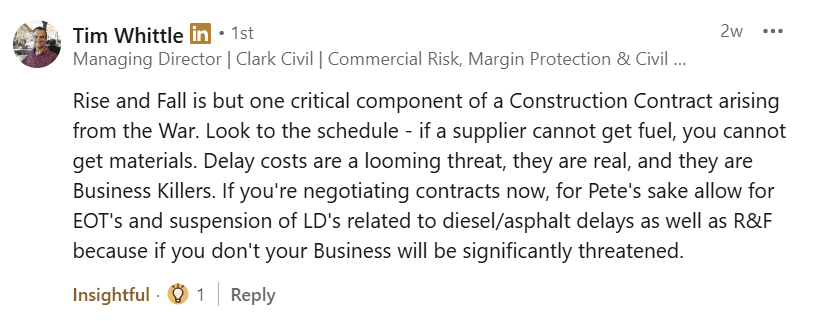
Tim Whittle LinkedIn comment on the fuel crisis
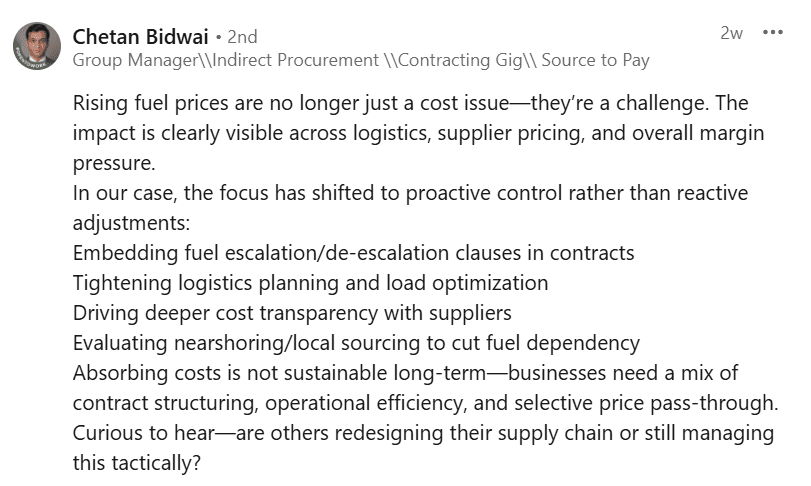
Chetan Bidwai LinkedIn comment on the fuel crisis
Section 4

Government and ATO Response

The ATO fuel response measures are available until 30 June 2026. For eligible ABN holders who can demonstrate that fuel costs have specifically impacted their capacity to meet tax obligations, the payment plan provides real cash flow relief. The fuel excise cut reduces costs at the pump from 1 April, but the benefit reverses immediately on 30 June if the conflict has not resolved.

Most of the relief measures are reactive. Businesses need to apply, demonstrate eligibility, and navigate ATO processes. This is worth doing, but it does not substitute for understanding your legal position on live contracts.

If you need advice on your specific situation, this is where to start →

Media

The ATO has launched temporary repayment plans for businesses struggling with surging fuel costs, and will limit compliance actions in the hardest-hit industries. Through the plan, eligible taxpayers can lock in three-year payment commitments, with equal monthly instalments and no upfront payment. The ATO's shift reverses a course of increasingly stern compliance measures that had been in place since the end of COVID-19 restrictions.

SmartCompanySmall Business News, Australia
Official Source

The ATO recognises that high fuel costs are affecting some businesses and will provide targeted support to eligible businesses unable to meet their payment obligations for three months, until 30 June 2026. This includes streamlined access to more flexible payment plan arrangements, including longer payment terms, no upfront payment, and access to general interest charge remission. If high fuel costs are affecting your business's ability to meet tax payment obligations and you are having difficulty getting working capital financing from your bank, please let us know.

Rob Heferen, Commissioner of TaxationAustralian Taxation Office
1 April 2026ato.gov.au
Official Source

From 1 April to 30 June 2026, the fuel excise tax has been cut in half, from 52.6 cents per litre down to 26.3 cents per litre. The Heavy Vehicle Road User Charge, previously 32.4 cents per litre, has also been dropped to zero for the same three-month period. Fuel tax credit rates for heavy vehicles on public roads are now 20.2 cents per litre, and for other business use off-road, 52.6 cents per litre. When the relief ends on 30 June, prices jump straight back up if the conflict has not been resolved.

Australian Taxation OfficeATO Fuel Response
1 April 2026ato.gov.au
Media

We can't control the war in the Middle East. We can't stop the war in the Middle East, but what a responsible government can do is do everything it can to shield its citizens and to shield small businesses. The ATO has agreed to provide temporary relief for businesses unable to meet their tax obligations due to fuel supply issues, including more generous payment plans, remission of interest and penalties, and support in PAYG instalments where there's been a downturn in tax income.

Anne Aly, Small Business MinisterAustralian Federal Government
March 2026sbs.com.au
Section 5

Insolvency, Licensing and Business Survival

The insolvency wave that followed COVID-19 has not fully unwound. Construction remains the highest-risk sector for insolvency in Australia. What the fuel crisis has added is a new trigger point for businesses that were already operating on thin margins, and a new source of uncertainty for builders who do not know what would happen to their QBCC licence or home warranty insurance if they needed to restructure. Marcus Petrovic's contributions below speak directly to that uncertainty: many builders in financial difficulty delay restructuring because they cannot get a clear answer on what restructuring would mean for their licence and their ability to keep operating.

The pattern is consistent: a business wins work at a competitive margin, costs rise during delivery, the margin compresses, cash flow tightens, and a payment dispute or variation rejection breaks the position.

This is where Blaze Business & Legal comes in, providing business, financial management and cash flow, legal, commercial, operational and compliance advice for businesses that are struggling but do not yet need to turn to formal restructuring and insolvency mechanisms. For those businesses that are in financial distress, directors who engage early, while the Small Business Restructure pathway and the statutory safe harbour under the Corporations Act are still available, have significantly better options than those who wait.

We have written about why builders go broke in Australia and what the early warning signs look like →

Insolvency

It's not just the variation in rules between states that creates confusion. It's the uncertainty around whether builders and tradespeople will actually be able to start again and retain their licence and insurance. Outcomes for similar situations can differ not only across states, but more concerningly, even within the same state authority. That uncertainty often leads to people putting their heads in the sand until things get too far gone. If there was more clarity and confidence around these issues, I think more people would make the call to restructure earlier.

Marcus PetrovicDirector, Mackay Goodwin Insolvency Practitioners, Sydney
Insolvency

There remains a critical and often underemphasised issue: the lack of consistency between state regulatory bodies, particularly in relation to licensing and home warranty insurance. Key areas of uncertainty include the treatment of a licence if insolvency occurs, whether it is automatically terminated, suspended or subject to a review process, the timeframe for reapplying, and the status of home warranty insurance during and after restructuring. These are fundamental questions for which even experienced industry professionals are often unable to provide definitive answers.

Marcus PetrovicDirector, Mackay Goodwin Insolvency Practitioners, Sydney
Academic Research

Even before this Middle East war, construction already had more insolvencies than any other industry, more than doubling since COVID. Despite huge demand for new housing, the 2024-25 financial year saw a record 3,490 construction firms enter insolvency. When builders collapse, the contagion spreads quickly: tradies lose jobs, subcontractors go under, projects stall and consumers face financial and emotional devastation. If this oil crisis lingers, more builders are likely to go bust, slowing down housing supply.

Lyndall Bryant, Amanda Bull, Elizabeth Streten et al.QUT Centre for Justice, Queensland University of Technology
31 March 2026theconversation.com
Insolvency

Directors concerned about the financial impact of rising fuel costs on cash flow need to understand what restructuring options are available. The statutory safe harbour regime under the Corporations Act 2001 can support genuine restructuring attempts while providing protection for directors who might otherwise face personal liability for insolvent trading. Such options may be available even if the director suspects the company may be, or is, insolvent.

HWL Ebsworth LawyersNational Commercial Law Firm, Australia
Blaze Business & Legal

Businesses delay restructuring not because they want to, but because they cannot get a clear answer on what will happen to their QBCC licence. Queensland's licensing regime has its own complexities, and those complexities do not pause for a fuel crisis. The businesses best placed are those that already understood their QBCC obligations and MFR requirements before things became urgent. By the time most call us, the options have narrowed.

Rachelle HareBusiness Adviser, specialist Construction Lawyer and Managing Director, Blaze Business & Legal

Contribute to This Report

At Blaze Business & Legal, we are in front of construction businesses every day. Shannon Drew, our Management Accountant and Fractional CFO, has been running the numbers on what is happening to margins across the industry. Rachelle Hare, our specialist Construction Lawyer, has been working through the contract implications.

Our current analysis puts the aggregate cost increase at 7 to 7.5 percent across the board, across fuel, materials, wages, super, insurance, interest rates, and government charges, with more to come in the second half of 2026. But numbers without voices are just numbers, and they don't tell us enough.

We want to hear from the people who are actually living this: contractors, subcontractors, principals, advisers, insurers, suppliers, financiers, industry bodies and commentators. Those who are struggling and those who are not. Those who have found solutions and those who are still looking.

All contributors will be credited and linked. Anonymous contributions can be published with your industry category and state noted.

Please include:

  • Your name, title and business name
  • How your business fits into construction or related industries (eg contractor or supplier)
  • Your state or territory
  • Your quote, comment, data or insights (one to three paragraphs)
  • A link to your website or social media for us to cite

Choose the section that best matches your experience, or contribute to more than one:

Section 1Financial Pressure and Fuel ShockWhat is the cost environment doing to your margins, cash flow, and working capital? Numbers welcome.
Section 2Material Costs and Supply ChainsWhat material and supply chain price movements are you seeing? Confirmed figures and supplier notifications welcome.
Section 3Contracts and Legal RiskWhat contractual challenges are you seeing? Rise and fall clauses, force majeure, fixed-price risk, notices, subcontract issues.
Section 4Government and ATO ResponseAre the government relief measures working for your business? What is missing from the policy response?
Section 5Insolvency, Licensing and Business SurvivalAre you seeing more businesses going under? Have you been personally affected? What are the warning signs?
Section 6The Bigger Picture and OutlookWhere do you think this ends? What does the construction industry look like at the end of 2026?
Email your contribution to this Report →

Important (please read)

This report draws on published articles, LinkedIn posts, direct correspondence and professional observations shared for the purpose of industry commentary. Quotes have been reproduced accurately and in full context to the best of Blaze Business & Legal's knowledge. Statistics in the stats bar are attributed to their sources. All source URLs were accurate at the time of compilation in April 2026. Rachelle Hare and Shannon Drew's contributions represent their perspective of, and obligations on, the construction industry and do not constitute legal, financial management or business advice.

If you believe your published article or post has been inaccurately quoted, or if you do not wish it to be shown on this page, please email enquiry@blazebusinessandlegal.com.au with the relevant information and we will promptly take it down.

Let’s Chat About How We Can Help You

  • Contact us to discuss how we can help you and your construction business
  • No-obligation quote for our services
  • We work to your budget and timeframes

Call Us

Email Us

enquiry@blazebusinessandlegal.com.au

Share With Your Network

Send Us a Message