


Key Takeaways about Security
Bank guarantees, insurance bonds and retention moneys are the three forms of security commonly used in Australian construction projects.
The Construction Contract between the parties states the requirements for providing security and having it released to the Contractor, as well as how the Principal must have recourse to the Security and when it must be released.
Most Australian Standard form contracts are heavily amended, and the amendments often remove the notice protections that would warn you before your security is called.
In Queensland, a party can generally only use security to obtain an amount owed under the contract after giving written notice under s 67J of the QBCC Act. Failing to release retention or another security such as a bank guarantee in accordance with the contract without reasonable excuse is an offence in Queensland.
Types of Security in Australian Construction Contracts
Three types of security are commonly used in Australian Construction Projects: Bank Guarantees, Insurance Bonds and Retention Moneys (sometimes spelled “Retention Monies”).
1. Bank Guarantees
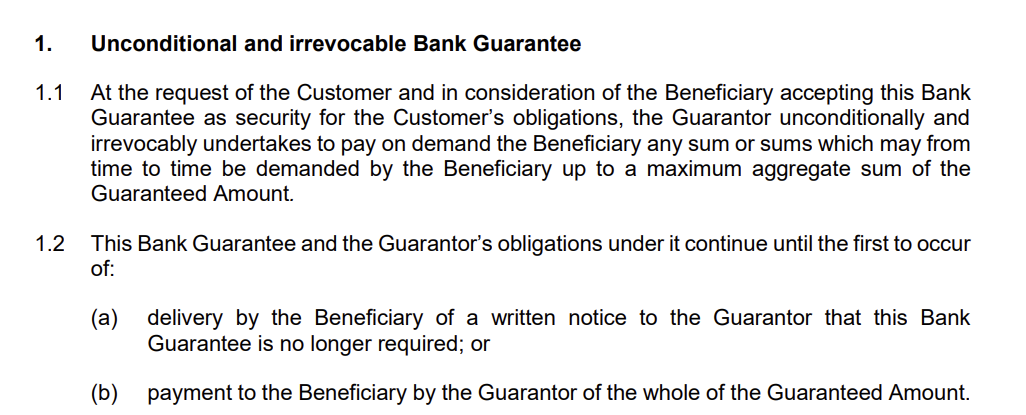
A bank guarantee is an unconditional undertaking from your bank to pay the Principal on demand, and the Principal treats it as good as cash. Every guarantee you have on issue reduces your banking facility headroom dollar for dollar, which is often the invisible constraint on taking your next Project.
The return of a bank guarantee generally cannot be claimed through a Security of Payment payment claim, which the Victorian Court of Appeal confirmed in J.G. King Project Management Pty Ltd v Hunters Green Retirement Living Pty Ltd [2024] VSCA 310, so recovering an instrument runs through the contract rather than the fast statutory path that applies to cash retention.
2. Insurance Bonds
An insurance bond is a surety instrument issued by an insurer rather than your bank, and it secures the Principal without consuming your banking facility. Insurers price bonds on your financial strength and track record, and some Principals accept them readily while others insist on bank paper, so check what the contract permits before you tender on the assumption you can use one.
For a growing Contractor, moving security from bank guarantees to insurance bonds can release genuine working capital.
3. Retention Moneys
Cash retention is deducted from your progress payments, usually at 10 percent of each claim until the total reaches 5 percent of the contract sum, and it is the form of security that hits your cash flow on every single claim.
Retention runs on its own lifecycle of withholding, trust protection and two-stage release, and we cover the full rules, the Queensland limits and how to keep yours moving on our Retention Money page.
If your retention is overdue right now, our guide on how to get retention money released takes you through the recovery process step by step.
Get Your Security and Retention Position Reviewed
The security provisions in your Construction Contract determine how much of your cash and bank facility sits locked up, for how long, and how easily the other side can take it. Rachelle Hare has drafted, negotiated and enforced security and retention clauses for 25+ years from both sides of the table.
If your retention money is overdue, a call on your bank guarantee is threatened, or you want the security clauses negotiated before you sign, speak with Rachelle directly and request a Fixed-Price Quote so you know the cost before you commit.
Providing Security When You Sign
The contract’s Item schedule or Annexure fixes the amount and form of security you must provide, and under AS 4000:2025 the details sit in Items 15 and 16, with delivered security other than cash or retention moneys transferred in escrow.
Around 5 percent of the contract sum is typical, and in Queensland the retention and security combined generally cannot exceed 5 percent of the contract price before Practical Completion or 2.5 percent after it.
The amount, the form, the preconditions to recourse and the release triggers are all commercial terms you can negotiate before signing, and that negotiation is where almost all of your protection is won.
Swapping One Form of Security for Another
Many contracts let you substitute one form of security for another at any time, and AS 4000:2025 clause 5.3 requires the holder to release and return your retention moneys or cash security as soon as practicable once substitute security is provided. Amended contracts often narrow or delete the substitution right, so read the clause before you build a cash flow plan around a swap.
Reasons why exchanging your withheld retention for a bank guarantee at Practical Completion, and how that can help your cash flow, are covered on our Retention Money page.
Release and Reduction of Security
Under AS 4000:2025 clause 5.4, your entitlement to have security reduced arises when the Certificate of Practical Completion issues, the reduction must be released and returned within 14 days, and the remaining entitlement ceases 14 days after the Final Certificate issues, with release to follow as soon as practicable. Security provided for plant and materials, which is often a separate bank guarantee, must be released 14 days after the plant and materials are incorporated into the Works.
In Queensland, a 12 month Defects Liability Period applies by default where the contract is silent or unclear on release, and failing to release security in accordance with the contract without reasonable excuse is an offence that applies to bank guarantees as much as cash. If your contract has been terminated, each party must release the other’s security as soon as practicable after every dispute touching the security is resolved, so keep the release obligation on the table in any termination negotiation.
QBCC Security Requirements at a Glance
Queensland regulates security under building contracts more heavily than any other Australian jurisdiction, and the requirements below set out how much can be held, when notice must be given, when release falls due and how your money is protected
1Limits on the Security That Can Be Held
2Using Security
3Releasing Security
4Trust Account Protection
5Claiming Your Money
Facing a Call on Your Security
A call converts your guarantee or bond into the Principal’s cash, and stopping an improper call is measured in days, not weeks. Most Australian Standard form contracts in circulation are heavily amended, and the amendments often remove the notice requirements entirely, so never assume you will be warned first.
The unamended AS 4000:2025 requires at least 5 days to pass after notice of intention before recourse, and in Queensland s 67J of the QBCC Act separately requires written notice of the proposed use and the amount owed within 28 days of the holder becoming aware of its right, though the Queensland Supreme Court confirmed in Rawcorp Pty Ltd v MDP No 15 Pty Ltd [2026] QSC 38 that the statutory notice only applies to liquidated amounts owed and not to unliquidated damages claims.
If you receive a notice of intention and want to stop the call, contact your Construction Lawyer the same day, because an injunction may need to be sought and served before the security is converted, and the window closes fast.
Security Held in Trust
Under AS 4000:2025 clause 5.5, any security that is cash or retention moneys, together with interest earned on it, must be held in trust for the party providing it until the Principal or the Contractor becomes entitled to receive it, unless a government body holds it.
Queensland goes further with a statutory trust regime, requiring cash retention to be held in a retention trust account where a Project Trust applies, and the QBCC’s online trust account tool tells you whether an account is required on your contract. The full trust account rules, the trustee’s notice obligations and how to verify your money is protected are covered on our Retention Money page.
Rachelle Hare, In my experience
Over 25+ years I have advised on and resisted more calls on bank guarantees than I can count, and the call clause was decisive every time. Where the clause required a determined entitlement before recourse, we stopped the call or negotiated it away, and where the clause allowed recourse on the Principal’s opinion alone, the money was usually gone before anyone rang me. Get the call clause right before you sign, because that single drafting choice determines whether your guarantee works as security or simply as the Principal’s cash.
How Rachelle Helps to Protect Your Security and Cash Flow
Rachelle reviews the security, recourse and release provisions as part of every Construction Contract Review, prepares Statements of Departures that push back on one-sided security clauses at tender stage, and advises urgently when a call on your security is threatened or a release has stalled. Every engagement runs on a Fixed-Price Quote, so you know the cost before you commit. Tell Rachelle what security you have on issue and what the contract says, and she will tell you where you stand.
Call Rachelle direct. Request a Fixed-Price Quote.
FAQs about Security in Construction Contracts
How much security can a Principal hold on a construction contract. Should a Contractor provide a bank guarantee or cash retention. Can a Principal call on a bank guarantee without giving notice. Can a call on a bank guarantee be stopped. When must security be released under AS 4000. Is interest payable on security held in trust. Can the return of a bank guarantee be claimed under the Security of Payment Act. Do the Queensland security limits apply to every contract. Does security have to be released after termination. Who holds security when a retention trust account applies.
Get Your Security Position Reviewed
The security provisions in your contract determine how much of your money and facility capacity sits locked up, for how long, and how easily the other side can take it. Have Rachelle read them before you sign, or before you rely on them.
FAQs about Security in Construction Contracts
Around 5 percent of the contract sum is the standard commercial position, provided as bank guarantees, insurance bonds, cash retention or a mix. In Queensland that figure is also the legal cap under ss 67K to 67N, QBCC Act, with the combined total dropping to 2.5 percent of the contract price after Practical Completion.
Each option costs you in a different place, because cash retention comes straight out of your progress payments while a bank guarantee consumes your banking facility headroom instead. The right answer depends on your margin, your facility capacity and what the contract permits, so price both before you tender rather than accepting the default in the draft.
Under an unamended AS 4000:2025, at least 5 days must pass after notice of intention before recourse, and in Queensland s 67J, QBCC Act separately requires written notice where the call is for an amount owed under the contract. Most contracts in circulation are heavily amended though, and the Queensland Supreme Court confirmed in Rawcorp Pty Ltd v MDP No 15 Pty Ltd [2026] QSC 38 that the statutory notice does not apply to unliquidated damages claims, so read your call clause rather than assuming you will be warned.
An improper call can sometimes be restrained by injunction, where the caller has not met the contract’s preconditions to recourse or the required notices were never given. The window is measured in days before the guarantee converts to cash, so contact your Construction Lawyer the same day any notice of intention arrives.
Under AS 4000:2025 clause 5.4, the entitlement to security reduces when the Certificate of Practical Completion issues and the reduction must be released within 14 days, with the remaining entitlement ceasing 14 days after the Final Certificate. Security provided for plant and materials, often a separate bank guarantee, must be released 14 days after the plant and materials are incorporated into the Works.
Under AS 4000:2025 clause 5.5, cash security and the interest earned on it are held in trust for the party providing them, while interest on security not required to be held in trust belongs to the holder. Check your own contract’s trust and interest wording, because amendments to clause 5.5 are common.
The release of cash retention can be enforced through a payment claim, while the return of a bank guarantee generally cannot, as the Victorian Court of Appeal confirmed in J.G. King Project Management Pty Ltd v Hunters Green Retirement Living Pty Ltd [2024] VSCA 310. Recovering an instrument instead runs through the contract, the Queensland notice regime, or an injunction where a call is threatened.
The caps in Part 4A, QBCC Act apply to building contracts, including commercial head contracts and subcontracts on residential projects, while contracts with resident home owners sit under the domestic building rules. Some carve-outs exist, including work within the mining exclusion, and the parties can contract out of the pre-completion cap only by complying with s 67K, so check which regime your contract sits in before relying on the limits.
Under AS 4000:2025, each party must release and return the other’s security as soon as practicable after every dispute touching an entitlement to that security is resolved. Keep the release obligation on the table in any termination negotiation, because holders quietly sit on security long after the disputes that justified holding it have settled.
The withholding party holds your cash retention as trustee in a dedicated retention trust account, and must notify you of the account and give you payment advices for deposits and withdrawals. You can confirm the account exists on the public QBCC Trust Account Register, and request trust transaction information from the trustee at any time.